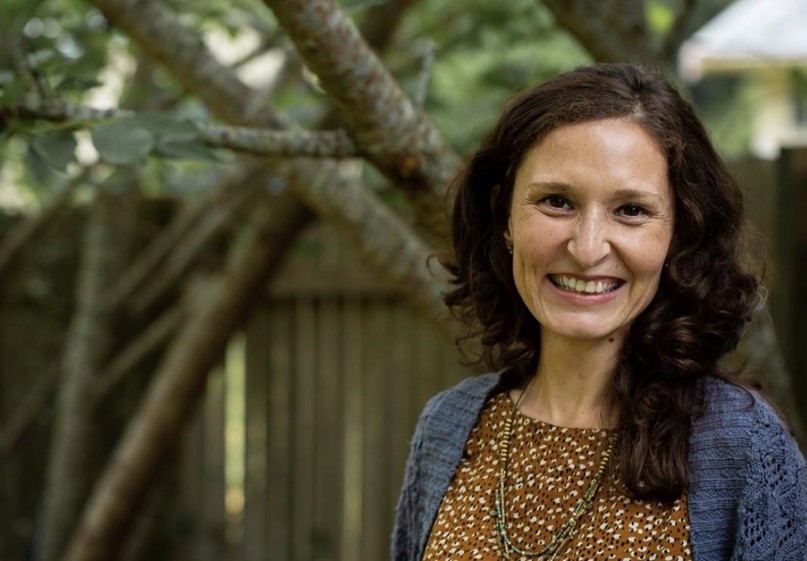
Eco anxiety, as a response to the environmental crisis, is an emerging area of study for psychologists, and art therapy is a potential salve for sufferers. Meet Mishy Rowan, and find out what happens when art meets science.
Key Points:
Eco anxiety is a type of anxiety that results from witnessing the destruction of our environment.
Eco anxiety is experienced at higher levels by younger people, higher educated people and women.
A bit of eco anxiety can lead to action and choices that help the planet, while too much can lead to burnout, eco-paralysis or inaction. Art is one way to temper high levels of anxiety.
Art therapistMishy Rowan of Lawson knows first-hand the power of art therapy. When surgery left her experiencing severe and ongoing pain, Mishy discovered that while painting, her pain disappeared. In a classic lightbulb moment, she connected art with therapy and could see how the act of being creative might help humans overcome life’s challenges.
She subsequently left her career in IT and, after completing a Master of Art Therapy, began her practice helping others use art to overcome challenges and improve wellbeing.
Now well established in her art therapy practice, Mishy is undertaking a Master of Psychological Practice. Her thesis is focused on eco-anxiety in response to the environmental crisis, whether it can be differentiated from general anxiety and how it can be measured. I had a chat with Mishy about her findings.
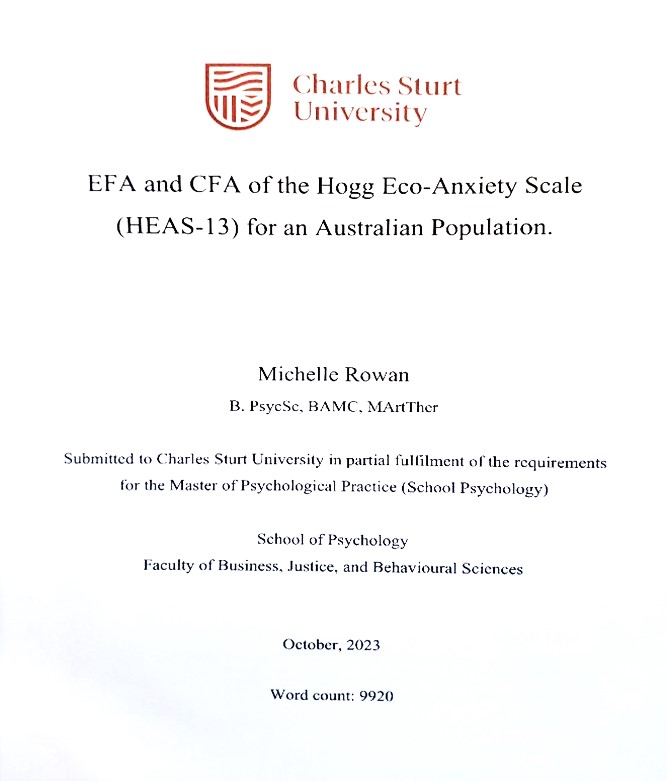
Title page of Mishy’s thesis.
Q: Can you tell me about the aim of your thesis?
Eco-anxiety is an emerging area of research and there’s a debate about whether eco-anxiety can (and should) be differentiated from general anxiety. So, the aim of my research was to investigate whether an eco-anxiety scale could be used as a valid tool for measuring eco-anxiety in the general population.
In psychology research, measurement tools help researchers gather empirical data. This allows us to analyse and understand aspects of human behaviour, cognition and emotions. Having a robust tool to measure eco-anxiety allows researchers and clinicians to identify vulnerable populations and tailor interventions accordingly.
My interest in this area grew out of one of the big questions in psychology around this topic: are therapists equipped to deal with the climate crisis? Whilst debate continues about this, my research was sparked by a desire to be able to answer this question with a confident ‘yes’.
Q: How is eco anxiety different to generalised anxiety?
Anxiety disorders can be characterised by persistent, excessive and often irrational worry or fear that significantly interferes with a person’s daily life. Eco-anxiety is theorised as a multidimensional construct which includes affective symptoms: that’s our emotions; behavioural symptoms: like losing sleep; rumination: so being unable to stop thinking about the environment; and anxiety about our personal impact on the planet.
Eco-anxiety has this existential element to it, which is the destruction of our environment. Similarly, much of therapy focuses on the intrapersonal: how we are inside; or the interpersonal: how we are in relationships. So eco-anxiety doesn’t fit neatly into these aspects as it’s a societal issue, it’s a global issue.
With eco-anxiety – because the environmental threat is real – it isn’t just about managing my emotions, improving my relationships, or changing my perspective on something. For some, the health of the planet is intrinsically linked to human health, which includes our mental health.
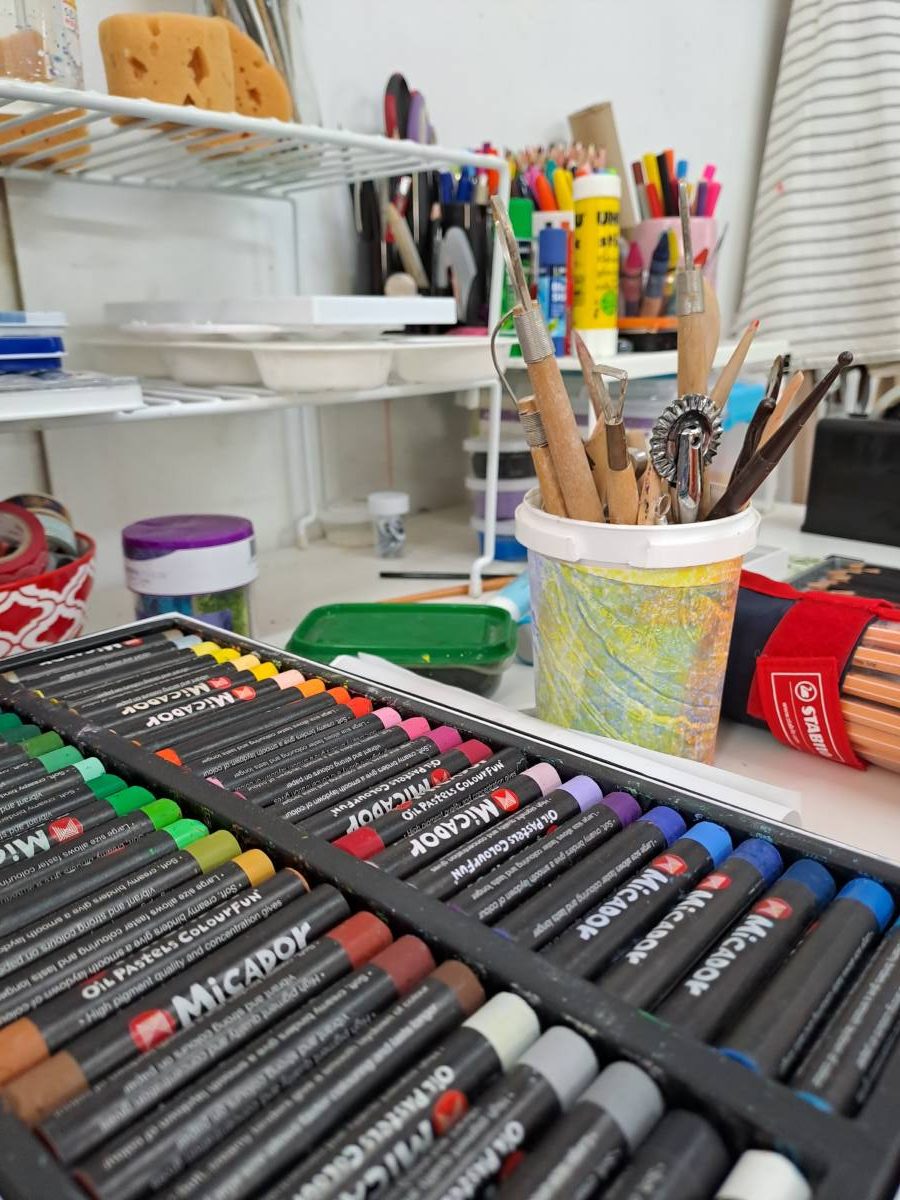
Art therapy tools at Mishy’s studio.
Q: So the scale you were testing in your thesis was different to a standard anxiety scale?
Yes. There’s a researcher in Australia who produced a scale that attempts to capture the multidimensional aspects of eco-anxiety. So far, the scale has only been tested within a small university sample. So my study replicated and extended the original study, with the aim of verifying the scale for use with a broader population.
Q: And what did your study find?
The study suggests that people resonate with the term eco-anxiety and that younger people, higher educated people, and women, tend to experience higher eco-anxiety levels. But within a broader population, we’re not 100% sure if the four constructs of the scale are necessarily the best way to capture eco-anxiety. So, as with most research, there is more work to be done!
Q: Was that a surprising outcome?
What was really interesting was that people relate to the term eco-anxiety differently across the generations. Older generations don’t necessarily relate to the term and the scale captured low levels of eco-anxiety amongst older populations, yet they tend to recycle more and be more conservative in their consumption, which reduces their carbon footprint.
Younger people tend to experience higher levels of eco-anxiety. At the same time, they’re actually recycling less and they’re consuming more (ie. fast-fashion, technology). So, they might be very worried about the environment, but their behaviours don’t always reflect that.
I was also surprised to see that a small percentage of the population indicated that they experience eco-anxiety every day. It’s a small but meaningful percentage with potential real-world consequences. For example, young people are being admitted into eating disorder clinics. They’re so concerned about the planet’s health that they have stopped eating. Whilst there are likely other factors at play that lead to hospitalisation, for some, eco-anxiety appears to be a contributing factor that may require a different treatment approach.
But what I found really encouraging is that, through the course of my research, I connected with a community of psychologists and art therapists who deeply care about the impact of climate change on our mental health. There is a whole community of health workers who are working hard to help individuals and communities manage the impact of climate change, and who are exploring better ways of supporting all of us through these changes.
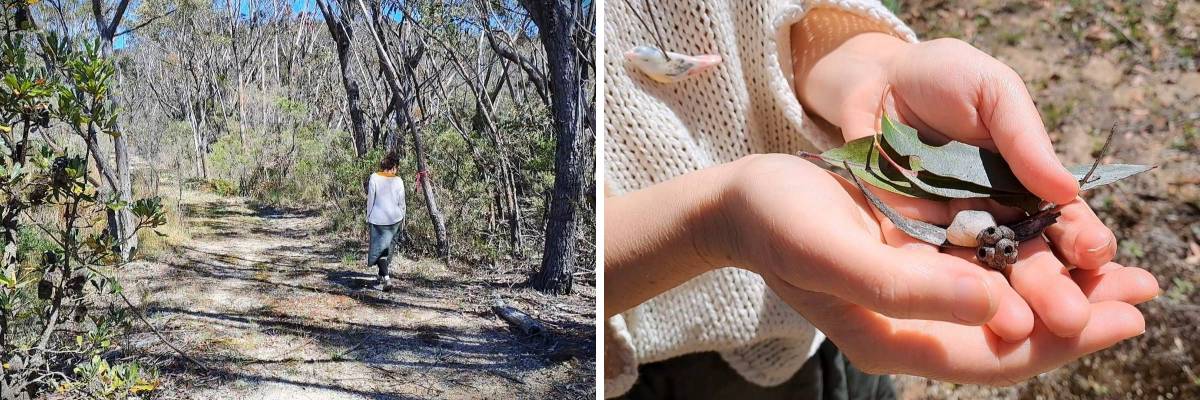
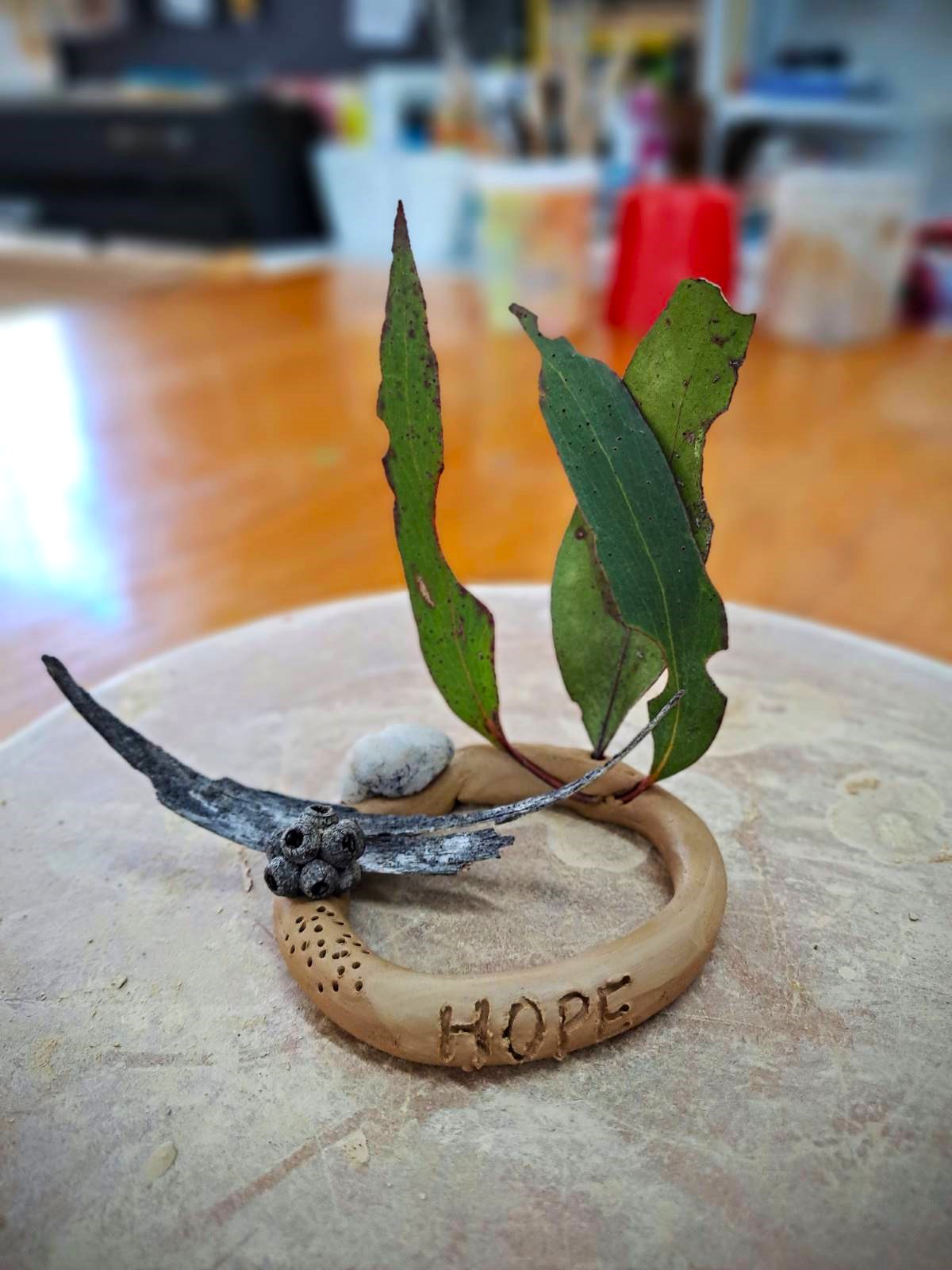
Mishy collecting items to use in the creation of her ‘nature ring’, an artwork activity she uses to process feelings of eco-anxiety.
Q: At best what function do you think eco anxiety can serve and at worst what damage can it do?
A little bit of eco-anxiety can be quite helpful. It may be motivating and help us to engage in pro-environmental behaviours, like recycling or activism. However, too much anxiety can lead to overwhelm, which may lead to ‘eco-paralysis’, where we become stuck. So, we need to find that sweet spot where anxiety is adaptive, where it helps to energise us and promotes change without overwhelming us.
At worst, eco-anxiety could mask general anxiety. It’s possible that one may hyper-focus on something external, such as the environment, whilst avoiding interpersonal or intrapersonal challenges that may be more related to general anxiety.
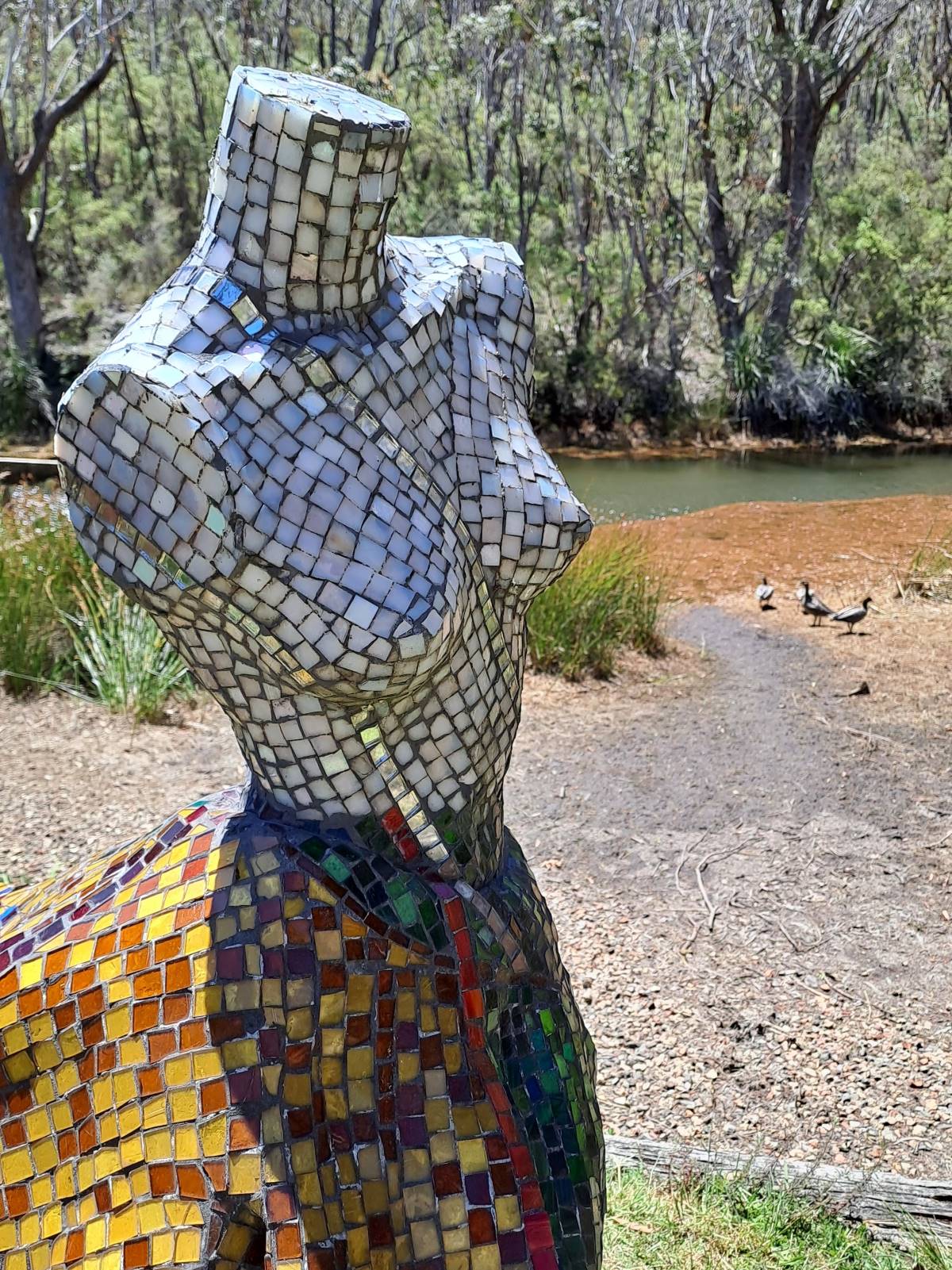
Sculpture and serenity on the grounds of Wild Valley Art Park in Wentworth Falls where Mishy has her art therapy practice.
Q: Do you see art therapy as a useful tool for eco anxiety?
Sometimes, when words are difficult to express, art making can be a useful form of non-verbal expression. Because of the abstract nature of climate change, it’s sometimes difficult to process these complex, existential feelings.
Art has been shown to have the potential to take abstract ideas and terms around climate change and present them in a way that’s more accessible for people. It also allows a direct connection to nature through the thoughtful collection and integration of natural elements in our artworks.
Q: Any other tips for dealing with eco anxiety?
While repairing the planet is a group effort, there are some things that we can do to help reduce symptoms of eco-anxiety. As individuals, it can be helpful to take control of our engagement with climate news and avoid ‘doom-scrolling’ to prevent overload.
Getting out in nature and participating in community events, be it activism or just sharing space with like-minded people, can also be beneficial. Expressing our concerns is also important. This might include talking with friends, family or a therapist, or writing, making art or music to help process our feelings so they don’t get trapped.
For me, what drives a lot of eco-anxiety is the question: is it on me to fix everything? The burden of that question can lead to overwhelm. So, my approach is to focus on the things I can control. I can’t necessarily change the amount of fast-fashion produced, but I can choose to upcycle, recycle and repair where possible, and importantly, to practice self-compassion when it is just not possible. Focusing on what’s in my control helps me to feel a sense of achievement which can reduce anxious feelings.
Mishy’s ‘nature ring’ that reflects her feelings about the environment.
How to make a nature ring
Mishy’s details if you would like to get in touch:
This story has been produced as part of a Bioregional Collaboration for Planetary Health and is supported by the Disaster Risk Reduction Fund (DRRF). The DRRF is jointly funded by the Australian and New South Wales governments.
We had a thoroughly enjoyable final Skill Share Saturday for the year yesterday with Qigong, Fashion Upcycling, Seed Saving and Bushcare! We shared seeds from local gardens and harvested carrots, as well as Mizuna, Broad Bean, Daikon and Land Cress seeds from the Planetary Health garden. We then packaged up (and shared) our first Upper Mountains Seed Savers packs for our fledgling Seed Bank. In Bushcare it`s very exciting to see whole new areas of the Planetary Health Precinct open up as we remove invasive weeds. It`s been a year of great progress as we`ve restored habitat for wildlife and given local native plants the opportunity to flourish and re-establish on the site.
Join the Planetary Health Centre this Sat 6 Dec for the last Skill Share Saturday of the year: Qigong at 9am, Seed Saving & Gardening Group at 10am, and Bushcare at 1.30pm. One perfect day with great company, great coffee and food, and great steps for living a healthy balanced life, while also contributing to the health of our planet for present and future generations. All ages welcome!
Registration links in profile and below.
Register for Qigong here: https://bit.ly/48wlHjD Register for Seed Saving & Gardening here: https://bit.ly/4prcRe7 Register for Bushcare here: https://bit.ly/4oAFDrz
We have a rare opportunity to learn about the newest and best possible ways to support family and community members struggling with mental health issues, at a free talk and afternoon tea provided by Upper Blue Mountains Sunrise Rotary at the Planetary Health Centre at 2pm this Saturday 29 Nov. Hear from Peter Joseph AM, Chair of the Black Dog Institute, and Professor Helen Christensen AO, Fellow of the Australian Academy of Science and former Executive Director and Chief Scientist at the Black Dog Institute. They`ll be in conversation with journalist Emma Rossi. Dr Christensen is a pioneer in using the internet to reach young people struggling with depression. Her digital mental health interventions are used by millions globally, delivering evidence-based therapy for depression, anxiety, and suicide prevention. Her research uses data from smartphones and wearables – like movement, screen use, and sleep – to detect early signs of mental health issues. Bookings essential here (link in profile): https://bit.ly/4oOnYxz
This Saturday Sherlie McMillan from Rotarians 4 Planetary Health will be running a workshop on How to use a sewing machine from 9am at the Planetary Health Centre in Katoomba. Learn how to set up a machine, service it, troubleshoot when it`s not sewing correctly, and learn some basic sewing skills.
Bookings essential here (link in profile): https://events.humanitix.com/how-to-use-your-sewing-machine
NB. This class is a prerequisite for our very popular Fashion Upcycling classes held once a month.
We`re thrilled to announce that Professor Helen Christensen, a pioneer in using the internet to reach young people struggling with depression, will be joining the conversation with Peter Joseph AM from the Black Dog Institute and journalist Emma Rossi at the Planetary Health Centre at 2pm this Saturday 29 November. Helen was the Executive Director and Chief Scientist for the Black Dog Institute for 10 years and has now been elected a Fellow of the Australian Academy of Science. Her digital mental health interventions are used by millions globally, delivering evidence-based therapy for depression, anxiety, and suicide prevention. Her research uses data from smartphones and wearables – like movement, screen use, and sleep – to detect early signs of mental health issues. This free event is being co-hosted by Upper Blue Mountains Sunrise Rotary and the Blue Mountains Planetary Health Initiative. Afternoon tea will be provided. Bookings essential here (link in profile): https://bit.ly/4oOnYxz
Human composting is increasingly being legalised around the world. Read about it in Katoomba Area Local News here (link in profile): https://www.katoombalocalnews.com/legalising-human-composting/
If you’d like to see this option available in NSW you can now sign a live petition to the NSW Parliament here (link in profile): https://bit.ly/43QIHbz
Thanks to everyone who contributed to deliver a fantastic Disaster Risk Awareness Expo and Family Day yesterday. @mark_greenhill_mayor opened the event at which we celebrated the 13th birthday of Betty the Asbestos Education House; @firecoat_au demonstrated and launched its range of fire retardant products that can help protect homes, gardens and even electricity poles; the Bushfire Retrofit Toolkit was launched; Santa arrived and delighted young and old; and @plantinspired99 and Action for Animals fed us all with a delicious plant-based sausage sizzle. The day was filled with talks, workshops, stalls and the sharing of a huge amount of expertise to keep us, and the other species we share our planet with, safe and healthy! @southkatoomba.rfb @nswses @fireandrescuensw @nswrfs @redcrossleura @redcrossau @shelter.building.design @firehalo.au @asbestosawareness @amelie_ecology @bbagsbluemtns @wireswildliferescue @handsheartfeet
Our marquee is up and we`re excited about our Expo and Family Day tomorrow (Sat 22 Nov). There`s something for everyone from a free sausage sizzle, plants from Santa and drumming and pollinator workshops, to sessions on keeping you and our community safe from extreme weather events and hazardous substances like mould and asbestos. Learn how intumescent paints can slow the spread of fire and pick up a sample pot; check out all our emergency service organisations; learn how to dispose of hazardous materials; paint a native orchid, make some seed balls or sew a boomerang bag to give as plastic-free Christmas presents this year; enjoy coffee and locally made sweets; and get tips on how to retrofit your home safely and beautifully to be prepared for future extreme weather events. View the full program and register here (link in profile): https://bit.ly/4nFrY1J
There are so many new and innovative ways of doing things, like the new cooking techniques being explored by Michael from Good Fat Pastry, and the new fire protection methods being launched at the Planetary Health Centre`s Expo and Family Day on Sat 22 Nov. Check out Michael’s recent presentation at the Food Security Fair in our video here: https://bit.ly/4pnXbIg (link in profile) and come along to taste his delicious carrot cake and pastries at the Expo on Saturday. Check out the program and register to attend here (link in profile): https://bit.ly/4nFrY1J
In 2006 Peter Joseph’s son Michael suicided after a 14-year episodic battle with mental illness. Peter is now the Chair of the Black Dog Institute which is working to achieve better outcomes for all those struggling with mental health issues. Journalist Emma Rossi will engage Peter in an intimate and moving conversation about a life of purpose and mental health advocacy. As a Rotary scholar Peter will also reflect on how Rotary helped shape his values and sense of purpose as a young man - and how those early lessons continue to guide his work today. This free event is being hosted by the Upper Blue Mountains Sunrise Rotary Club and the Blue Mountains Planetary Health Initiative on Saturday 29 November from 2-4pm at the Planetary Health Centre at 33-39 Acacia St Katoomba. Afternoon tea will be provided. Bookings essential here (link in profile): https://bit.ly/4oOnYxz
Learn about intumescent fire retardant paint and a range of other strategies to prepare for extreme weather events, and to manage hazardous materials, at the upcoming Expo and Family Day at the Planetary Health Centre on Sat 22 Nov. You can register to attend here (link in profile): https://bit.ly/4nFrY1J We checked out how intumescent paint works in this video.
When temperatures reach a certain point the intumescent paint begins to swell and expand, often up to 50 times its original thickness. It forms a thick, carbonaceous "char" that acts as an insulating barrier. This layer slows the rate at which heat reaches the structural elements and buys valuable time for people to safely exit a building during a fire. It makes the structure safer for firefighters and rescue teams. #intumescentpaint #fireretardant #bushfire @firecoat_au...
Mould, lead paint, asbestos, silica dust from engineered stone bench tops and a wide range of chemicals, are amongst some of the many hazardous substances entering our environment and negatively impacting our health. Asbestos is found in over 3000 products including textured paints, moulded garden pots, brake pads and clutch linings in older cars, floor and ceiling tiles, lino, fibro, roofing, pipes and gutters, hot water systems, backing for switchboards and insulation boards in air-conditioning ducts, insulation, sealants, fillers, caulking and adhesives, gaskets for industrial and lab equipment and more. We’ll have information to take away and Blue Mountains City Council and the Asbestos and Hazardous Materials Consultants Association (AHCA) will be running free workshops on how to identify and manage these hazardous substances at the Planetary Health Centre`s Disaster Risk Awareness Expo in Katoomba on Sat 22 Nov. Find out more and register to attend here (link in profile): https://bit.ly/4nFrY1J
Belle Butler is a writer, musician and occasional photographer. She likes mix-and-matching these artforms and often explores the same themes through each of them. Her short fiction has been published in numerous Australian literary journals and she recently received a WestWords Fellowship and Mentorship with Delia Falconer for her novel manuscript, ‘River.’ Hopefully it will be published one day.
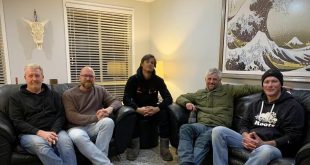
When Dan Gaffney found out he was having a son, it prompted action to break a cycle of inter-generational disconnection. What began as a personal commitment to self-work has since grown into a powerful communal practice helping men become more emotionally literate, accountable, conscious and connected.
Enjoyed this article? Please help spread the word :)
Support the Future of Solutions-Focused Neighbourhood News