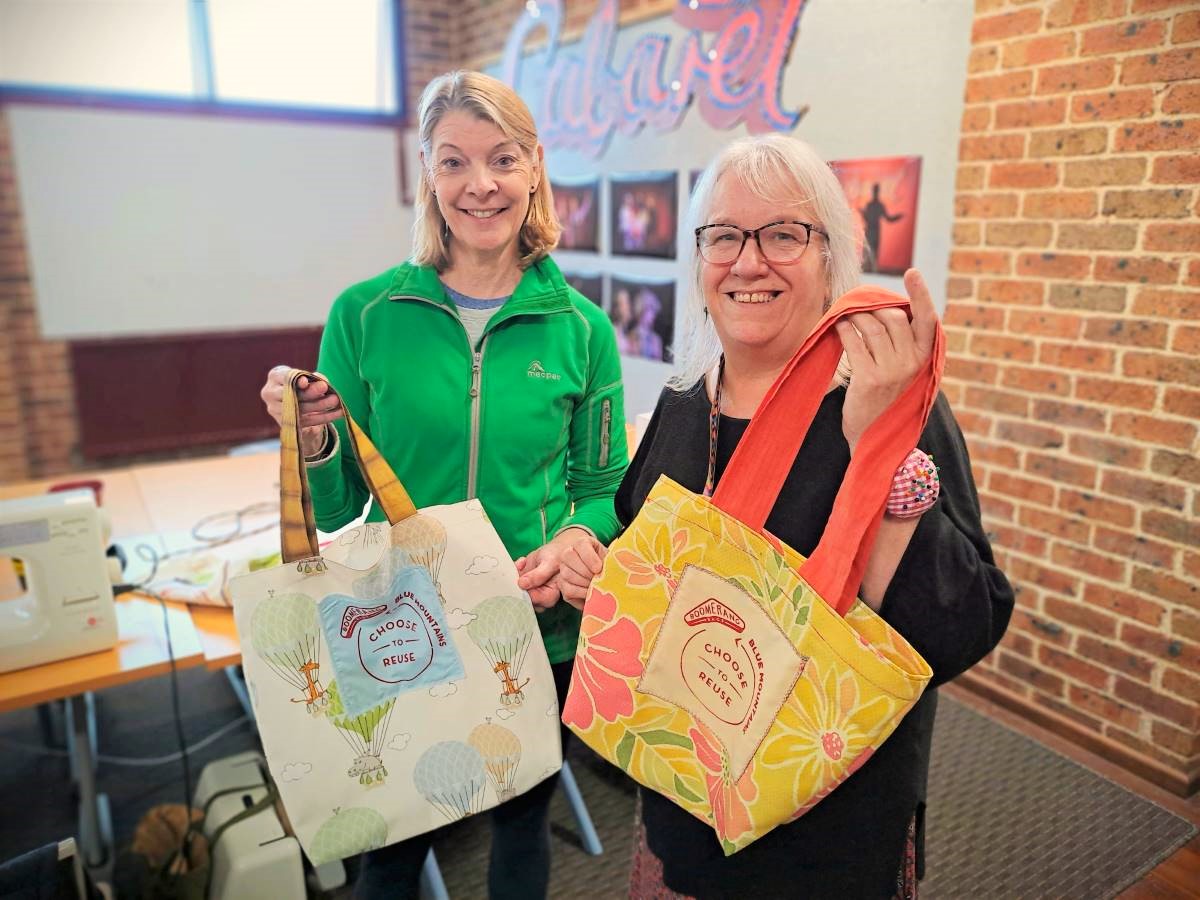
Alison Cameron and Maria De Luca: dedicated volunteers at Boomerang Bags Blue Mountains.
Story and photos by Belle Butler
Boomerang Bags Blue Mountains is part of a global, grassroots movement replacing single-use plastic bags with sustainable recycled fabric alternatives: one sewing bee at a time. The volunteers were hard at work when Belle Butler visited the group to find out more.
Key Points:
Single-use plastic bags and textile waste are two major environmental problems being tackled by grassroots movement, Boomerang Bags.
Boomerang Bags Blue Mountains meets at Korowal School on the first Saturday of the month to turn discarded fabric into usable, reusable carry bags.
The monthly sewing bees are a great way to learn how to sew, make friends and do something for the community and the environment.
Ever been to the shops and realised you’d left your bags at home? This is usually the moment I find myself walking out the shop doors with every pocket overfilled, and my teeth acting as a third set of fingers, just so that I can avoid the plastic bag that was offered to me. In this world in which it is difficult to make consistently pro-environmental choices, a group of Blue Mountains residents is working hard to make one choice a little bit easier.
On the first Saturday of every month, long-standing volunteers and newbies gather at Korowal School in Hazelbrook to sew re-usable bags out of recycled fabric for umbrella-initiative, Boomerang Bags. “We are tackling two problems at once: plastic bags and textile waste,” said Maria De Luca, who joined the local initiative in 2017 and became the group’s coordinator in 2019.
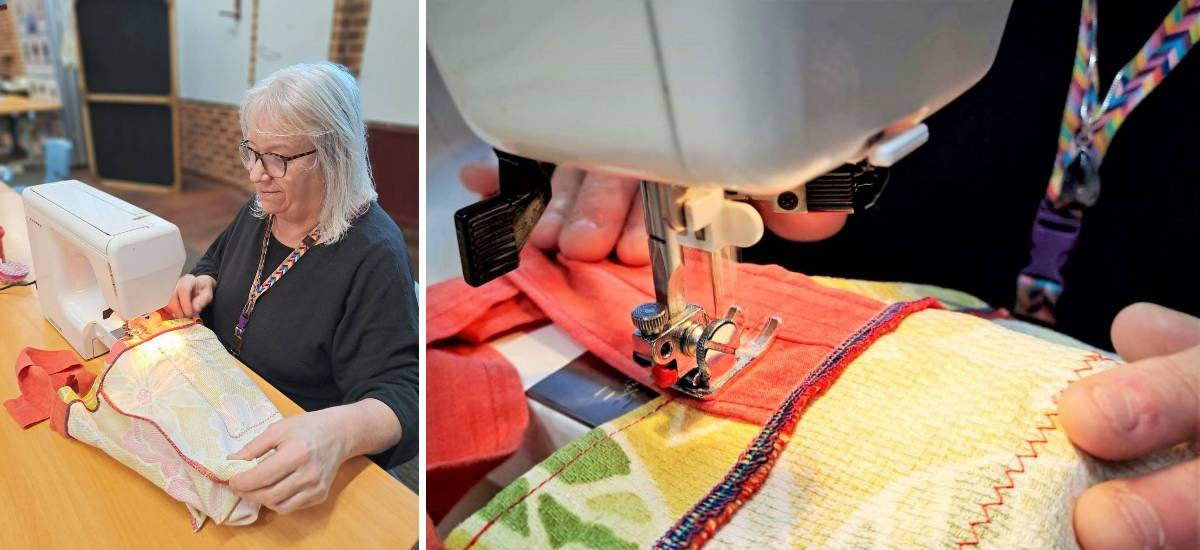
Maria De Luca happily hard at work.
Single-use plastic bags are petrochemical products designed to be used once and then thrown away. From production to disposal, their lifecycle has a significant and lasting impact on the environment, contributing to greenhouse gases and often ending up in the ocean where they kill wildlife and take many years to break down. Meanwhile, the textile industry is responsible for 92 million tonnes of waste globally each year.
Founders of the original Boomerang Bags in Burleigh Heads, Jordyn De Boer and Tania Potts, realised that by diverting textile waste from landfill and giving it another life in the shape of a bag, they could also drastically reduce plastic bag waste. Putting a call out to friends, family and community they gathered donations of recycled fabric and mobilised volunteers to turn that fabric into bags. Community sewing bees were formed and so began what is now a worldwide initiative that has diverted an estimated 180,000 kilograms of waste from landfill since its inception in 2013.
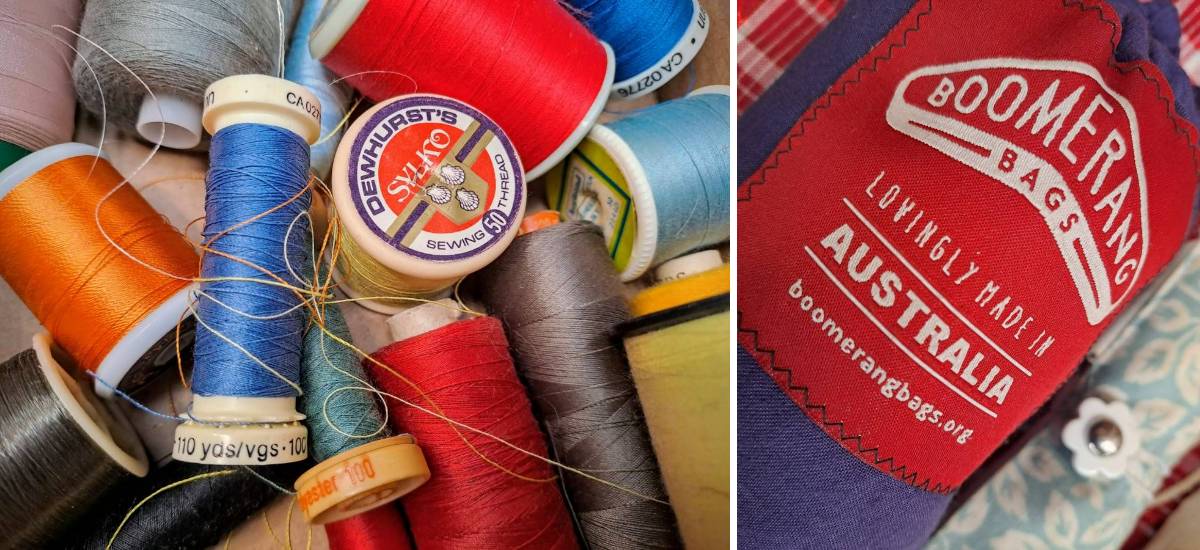
Tools of the trade and labels used to identify which region the bags were made in.
Boomerang Bags now has over 1,100 volunteer communities around the world, including the Blue Mountains group, which supplies bags to the Cancer Wellness Support Op Shop in North Katoomba, Terry White Chemmart Wentworth Falls and the Food Co-op in Katoomba. The Blue Mountains group is hoping to supply more shops as they enlist more volunteers.
“Boomerang Bags Blue Mountains is about getting together, making friends, socialising and doing something for the environment all at the same time… and feeling good about it!” – Maria De Luca
She pointed out that Boomerang Bags takes a nuanced approach to the carry-bag problem, noting that other alternatives such as paper bags or newly made re-usable bags have their own negative impacts on the environment. According to the UN Environment Programme, “Paper bags contribute less to the impacts of littering but in most cases have a larger impact on the climate, eutrophication and acidification.” Newly made re-usable bags may also have significant production, transportation, and disposal impacts on the environment.
Using, and importantly reusing (as many times as possible), a bag made locally from diverted textile waste drastically reduces all of these environmental impacts.
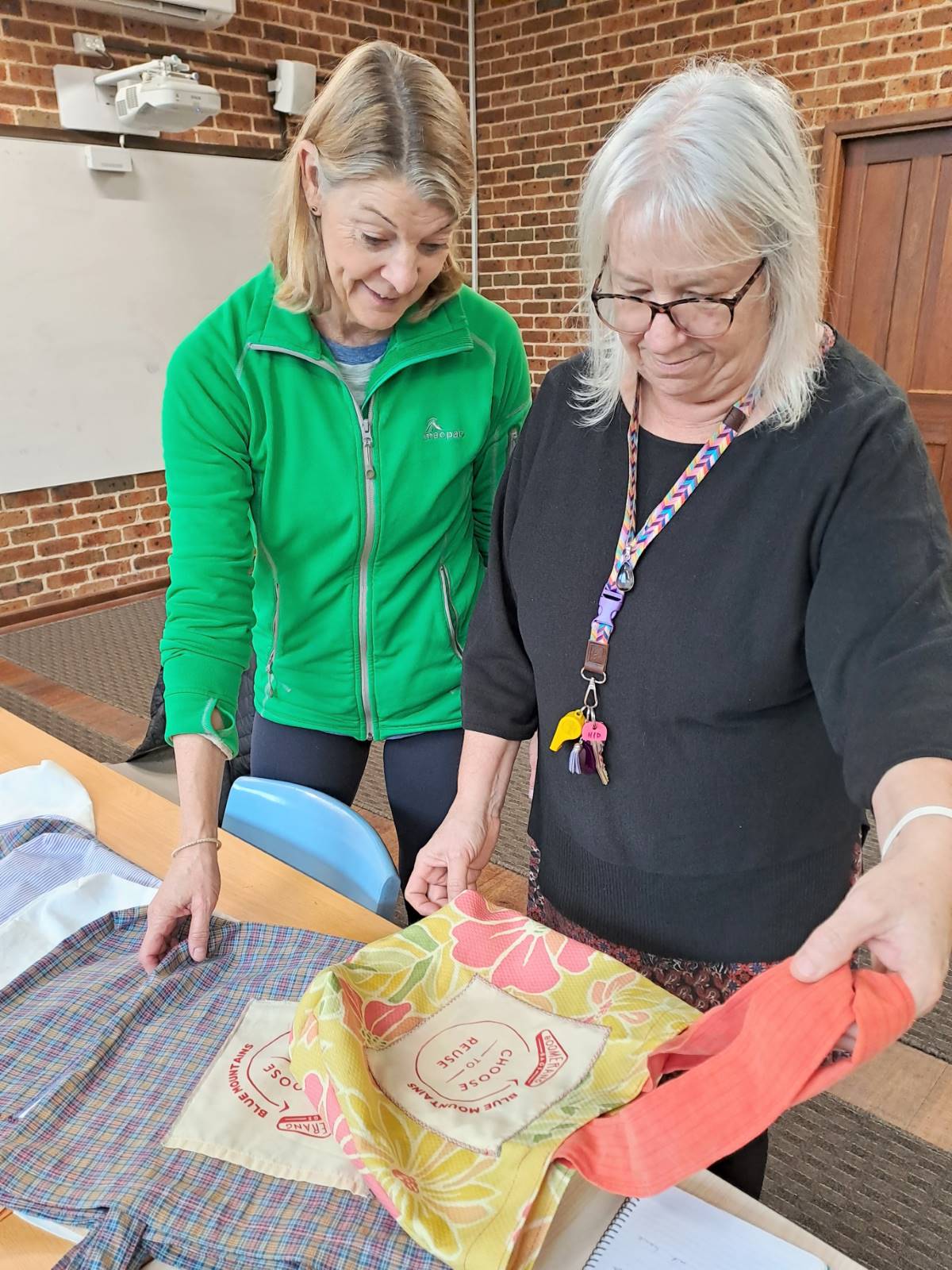
Alison and Maria admiring the various fabrics donated to the group.
While the plastic bag is a classic symbol of a throw-away culture that has become largely accepted and hard to escape, the ‘Boomerang Bag’ may be seen as a symbol of sustainable culture that embraces forgotten skills and old ways.
Alison Cameron, who joined the group in 2019 because she loved to sew and wanted to do something for the community and the environment, commented on the changes she has observed in her lifetime: “All this has been introduced within our lives. We used to use cloth napkins, we only had one doll, etc. Then things were introduced to make life ‘better,’ and now at this end of our lives we are trying to return to the old ways.”
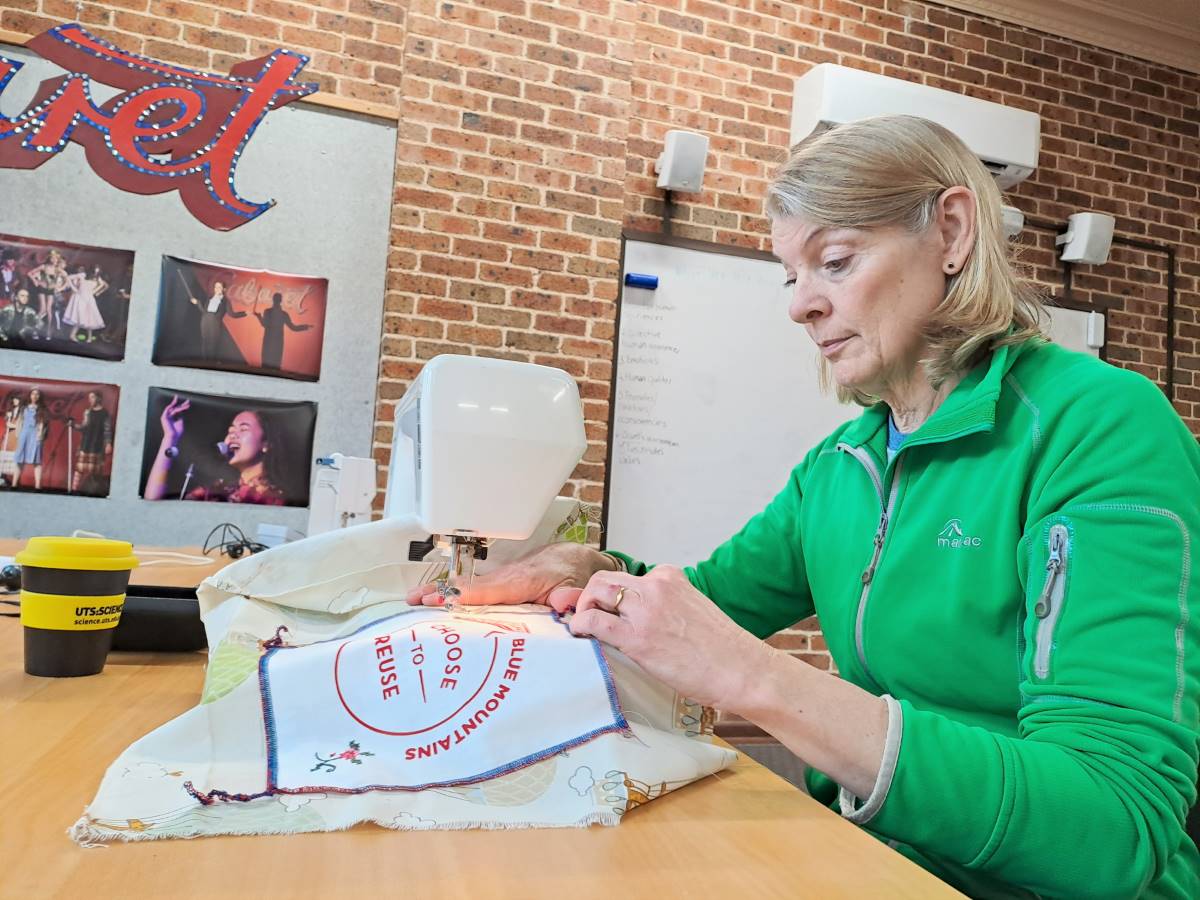
Alison sewing a label onto her bag.
The group inspires younger generations to ‘return to the old ways’ by teaching newcomers with little or no experience how to sew. Young children have even attended the group with their parents, learning a skill that will help them embrace sustainable habits and feed their creativity along the way.
“The kids wanted to learn how to sew, and without a machine at home or a clue myself, I wasn’t sure how to do this,” said Erin, who attends the sewing bees with her young daughters.
“Boomerang Bags helped us all to make a bag, and the kids are keen to come for every session. The group is welcoming and it’s lovely to be able to learn with the kids. As well as learning how to sew and doing something for the environment, we have gained some great friendships through Boomerang Bags.”
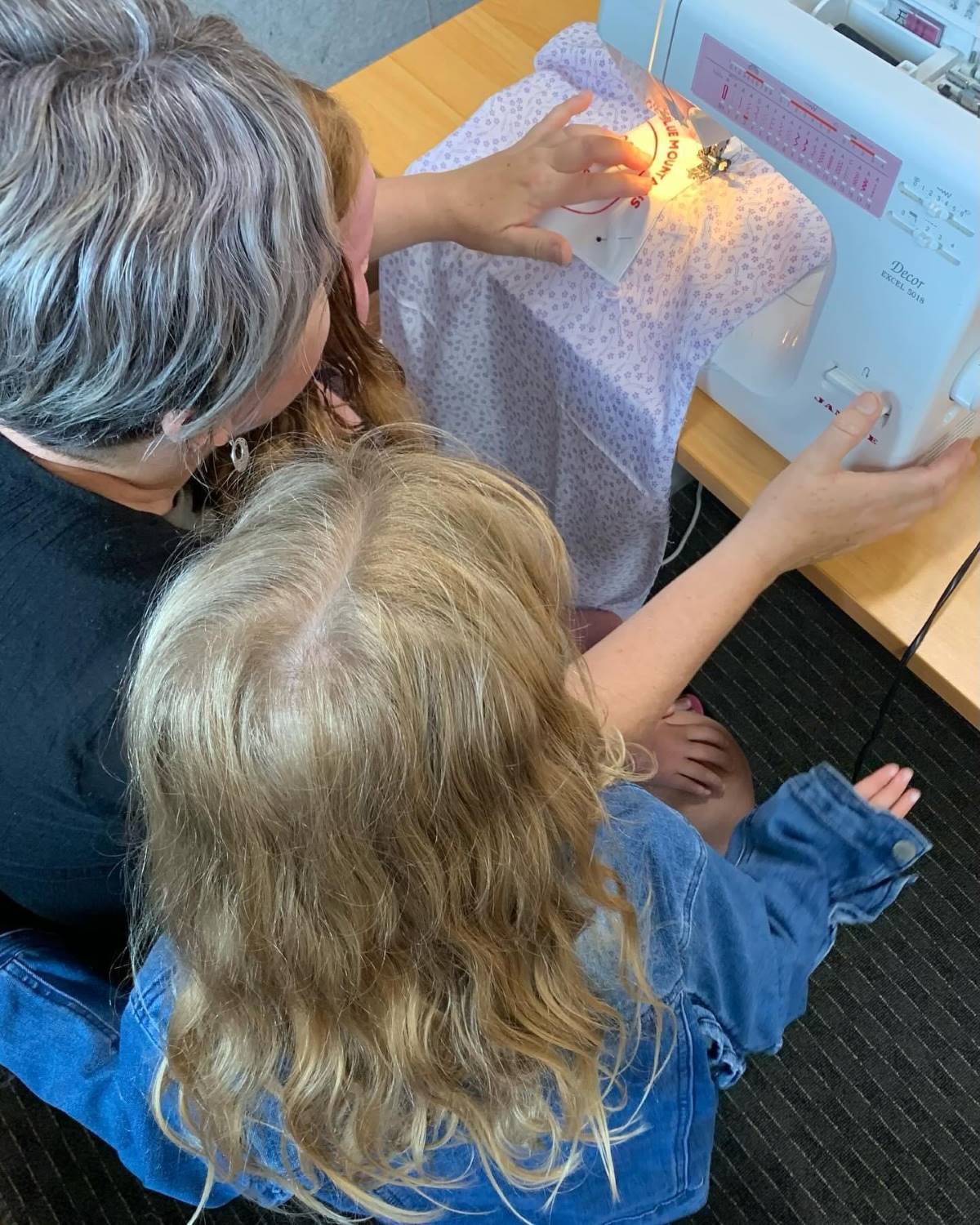
Erin and her daughter Bree learning to sew at Boomerang Bags Blue Mountains (photo supplied)
At Boomerang Bags Blue Mountains, all material has been donated by individuals or local op shops and is put to maximum use. “We get as much out of the material as we can,” said Maria. “Even if the material is threadbare, we’ll still use it by screen printing the labels on it, to minimise waste.” Leftover scraps are collected and used for filling in other projects, such as a homemade ottoman Maria is currently working on.
Most of the volunteers are so dedicated to the cause that they sew bags at home as well as during the monthly sewing bees. Often leaving small, individualised marks on their work, they find great joy in spotting their bags being used by the community. “Sometimes I find myself looking around the shops for my bags,” said Alison, “then I get really excited when I see someone using one of them.”
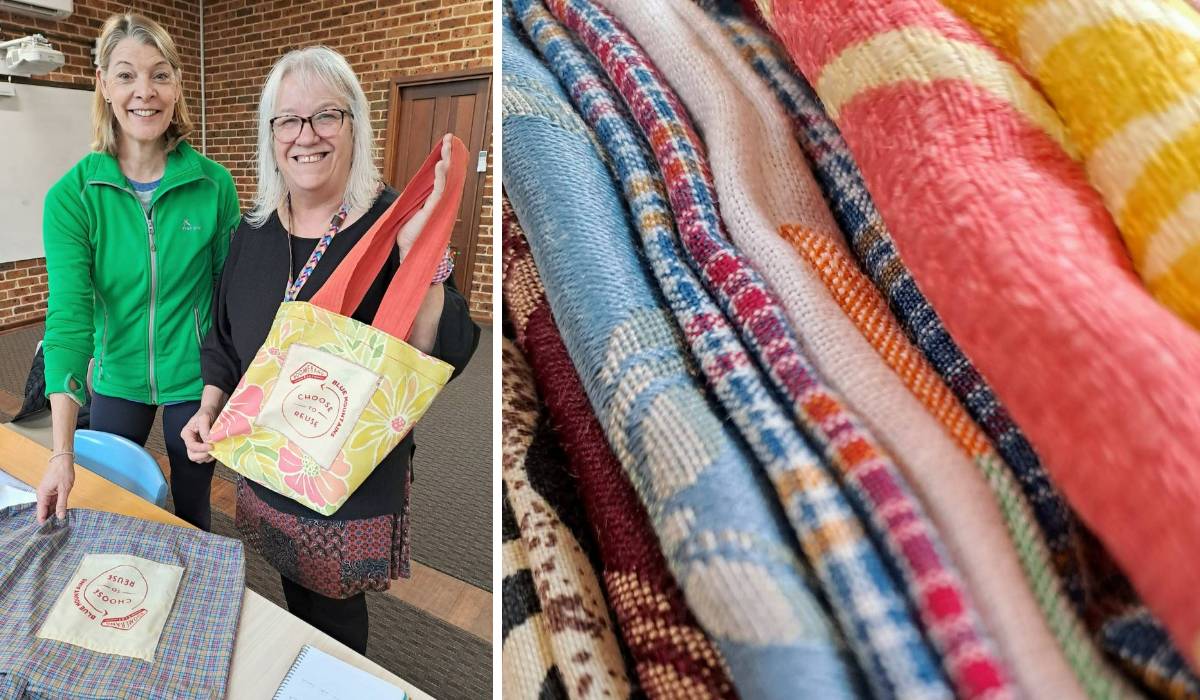
Left: Alison and Maria with their latest creations. Right: A bundle of bags ready to go out and be used (and reused).
Maria, who is also the Korowal representative for the Blue Mountains Sustainable Schools Network, was recently nominated for a Blue Mountains City Council ‘Binfluencer’ Award for her work with Boomerang Bags and her efforts in waste management as Teacher Librarian at Korowal School, where she has introduced two initiatives to reduce waste at the school: Return and Earn and Simply Cups.
She encourages the community to grab a few Boomerang Bags and use them as much as possible, donate fabric to the group, and come along to the monthly sewing bees to learn how to sew, make friends, and be part of the solution.
“Come and have a chat with me,” she said. “We’ll talk rubbish… literally.”
This story has been produced as part of a Bioregional Collaboration for Planetary Health and is supported by the Disaster Risk Reduction Fund (DRRF). The DRRF is jointly funded by the Australian and New South Wales governments.
We had a thoroughly enjoyable final Skill Share Saturday for the year yesterday with Qigong, Fashion Upcycling, Seed Saving and Bushcare! We shared seeds from local gardens and harvested carrots, as well as Mizuna, Broad Bean, Daikon and Land Cress seeds from the Planetary Health garden. We then packaged up (and shared) our first Upper Mountains Seed Savers packs for our fledgling Seed Bank. In Bushcare it`s very exciting to see whole new areas of the Planetary Health Precinct open up as we remove invasive weeds. It`s been a year of great progress as we`ve restored habitat for wildlife and given local native plants the opportunity to flourish and re-establish on the site.
Join the Planetary Health Centre this Sat 6 Dec for the last Skill Share Saturday of the year: Qigong at 9am, Seed Saving & Gardening Group at 10am, and Bushcare at 1.30pm. One perfect day with great company, great coffee and food, and great steps for living a healthy balanced life, while also contributing to the health of our planet for present and future generations. All ages welcome!
Registration links in profile and below.
Register for Qigong here: https://bit.ly/48wlHjD Register for Seed Saving & Gardening here: https://bit.ly/4prcRe7 Register for Bushcare here: https://bit.ly/4oAFDrz
We have a rare opportunity to learn about the newest and best possible ways to support family and community members struggling with mental health issues, at a free talk and afternoon tea provided by Upper Blue Mountains Sunrise Rotary at the Planetary Health Centre at 2pm this Saturday 29 Nov. Hear from Peter Joseph AM, Chair of the Black Dog Institute, and Professor Helen Christensen AO, Fellow of the Australian Academy of Science and former Executive Director and Chief Scientist at the Black Dog Institute. They`ll be in conversation with journalist Emma Rossi. Dr Christensen is a pioneer in using the internet to reach young people struggling with depression. Her digital mental health interventions are used by millions globally, delivering evidence-based therapy for depression, anxiety, and suicide prevention. Her research uses data from smartphones and wearables – like movement, screen use, and sleep – to detect early signs of mental health issues. Bookings essential here (link in profile): https://bit.ly/4oOnYxz
This Saturday Sherlie McMillan from Rotarians 4 Planetary Health will be running a workshop on How to use a sewing machine from 9am at the Planetary Health Centre in Katoomba. Learn how to set up a machine, service it, troubleshoot when it`s not sewing correctly, and learn some basic sewing skills.
Bookings essential here (link in profile): https://events.humanitix.com/how-to-use-your-sewing-machine
NB. This class is a prerequisite for our very popular Fashion Upcycling classes held once a month.
We`re thrilled to announce that Professor Helen Christensen, a pioneer in using the internet to reach young people struggling with depression, will be joining the conversation with Peter Joseph AM from the Black Dog Institute and journalist Emma Rossi at the Planetary Health Centre at 2pm this Saturday 29 November. Helen was the Executive Director and Chief Scientist for the Black Dog Institute for 10 years and has now been elected a Fellow of the Australian Academy of Science. Her digital mental health interventions are used by millions globally, delivering evidence-based therapy for depression, anxiety, and suicide prevention. Her research uses data from smartphones and wearables – like movement, screen use, and sleep – to detect early signs of mental health issues. This free event is being co-hosted by Upper Blue Mountains Sunrise Rotary and the Blue Mountains Planetary Health Initiative. Afternoon tea will be provided. Bookings essential here (link in profile): https://bit.ly/4oOnYxz
Human composting is increasingly being legalised around the world. Read about it in Katoomba Area Local News here (link in profile): https://www.katoombalocalnews.com/legalising-human-composting/
If you’d like to see this option available in NSW you can now sign a live petition to the NSW Parliament here (link in profile): https://bit.ly/43QIHbz
Thanks to everyone who contributed to deliver a fantastic Disaster Risk Awareness Expo and Family Day yesterday. @mark_greenhill_mayor opened the event at which we celebrated the 13th birthday of Betty the Asbestos Education House; @firecoat_au demonstrated and launched its range of fire retardant products that can help protect homes, gardens and even electricity poles; the Bushfire Retrofit Toolkit was launched; Santa arrived and delighted young and old; and @plantinspired99 and Action for Animals fed us all with a delicious plant-based sausage sizzle. The day was filled with talks, workshops, stalls and the sharing of a huge amount of expertise to keep us, and the other species we share our planet with, safe and healthy! @southkatoomba.rfb @nswses @fireandrescuensw @nswrfs @redcrossleura @redcrossau @shelter.building.design @firehalo.au @asbestosawareness @amelie_ecology @bbagsbluemtns @wireswildliferescue @handsheartfeet
Our marquee is up and we`re excited about our Expo and Family Day tomorrow (Sat 22 Nov). There`s something for everyone from a free sausage sizzle, plants from Santa and drumming and pollinator workshops, to sessions on keeping you and our community safe from extreme weather events and hazardous substances like mould and asbestos. Learn how intumescent paints can slow the spread of fire and pick up a sample pot; check out all our emergency service organisations; learn how to dispose of hazardous materials; paint a native orchid, make some seed balls or sew a boomerang bag to give as plastic-free Christmas presents this year; enjoy coffee and locally made sweets; and get tips on how to retrofit your home safely and beautifully to be prepared for future extreme weather events. View the full program and register here (link in profile): https://bit.ly/4nFrY1J
There are so many new and innovative ways of doing things, like the new cooking techniques being explored by Michael from Good Fat Pastry, and the new fire protection methods being launched at the Planetary Health Centre`s Expo and Family Day on Sat 22 Nov. Check out Michael’s recent presentation at the Food Security Fair in our video here: https://bit.ly/4pnXbIg (link in profile) and come along to taste his delicious carrot cake and pastries at the Expo on Saturday. Check out the program and register to attend here (link in profile): https://bit.ly/4nFrY1J
In 2006 Peter Joseph’s son Michael suicided after a 14-year episodic battle with mental illness. Peter is now the Chair of the Black Dog Institute which is working to achieve better outcomes for all those struggling with mental health issues. Journalist Emma Rossi will engage Peter in an intimate and moving conversation about a life of purpose and mental health advocacy. As a Rotary scholar Peter will also reflect on how Rotary helped shape his values and sense of purpose as a young man - and how those early lessons continue to guide his work today. This free event is being hosted by the Upper Blue Mountains Sunrise Rotary Club and the Blue Mountains Planetary Health Initiative on Saturday 29 November from 2-4pm at the Planetary Health Centre at 33-39 Acacia St Katoomba. Afternoon tea will be provided. Bookings essential here (link in profile): https://bit.ly/4oOnYxz
Learn about intumescent fire retardant paint and a range of other strategies to prepare for extreme weather events, and to manage hazardous materials, at the upcoming Expo and Family Day at the Planetary Health Centre on Sat 22 Nov. You can register to attend here (link in profile): https://bit.ly/4nFrY1J We checked out how intumescent paint works in this video.
When temperatures reach a certain point the intumescent paint begins to swell and expand, often up to 50 times its original thickness. It forms a thick, carbonaceous "char" that acts as an insulating barrier. This layer slows the rate at which heat reaches the structural elements and buys valuable time for people to safely exit a building during a fire. It makes the structure safer for firefighters and rescue teams. #intumescentpaint #fireretardant #bushfire @firecoat_au...
Mould, lead paint, asbestos, silica dust from engineered stone bench tops and a wide range of chemicals, are amongst some of the many hazardous substances entering our environment and negatively impacting our health. Asbestos is found in over 3000 products including textured paints, moulded garden pots, brake pads and clutch linings in older cars, floor and ceiling tiles, lino, fibro, roofing, pipes and gutters, hot water systems, backing for switchboards and insulation boards in air-conditioning ducts, insulation, sealants, fillers, caulking and adhesives, gaskets for industrial and lab equipment and more. We’ll have information to take away and Blue Mountains City Council and the Asbestos and Hazardous Materials Consultants Association (AHCA) will be running free workshops on how to identify and manage these hazardous substances at the Planetary Health Centre`s Disaster Risk Awareness Expo in Katoomba on Sat 22 Nov. Find out more and register to attend here (link in profile): https://bit.ly/4nFrY1J
Belle Butler is a writer, musician and occasional photographer. She likes mix-and-matching these artforms and often explores the same themes through each of them. Her short fiction has been published in numerous Australian literary journals and she recently received a WestWords Fellowship and Mentorship with Delia Falconer for her novel manuscript, ‘River.’ Hopefully it will be published one day.
When Dan Gaffney found out he was having a son, it prompted action to break a cycle of inter-generational disconnection. What began as a personal commitment to self-work has since grown into a powerful communal practice helping men become more emotionally literate, accountable, conscious and connected.
Enjoyed this article? Please help spread the word :)
Support the Future of Solutions-Focused Neighbourhood News