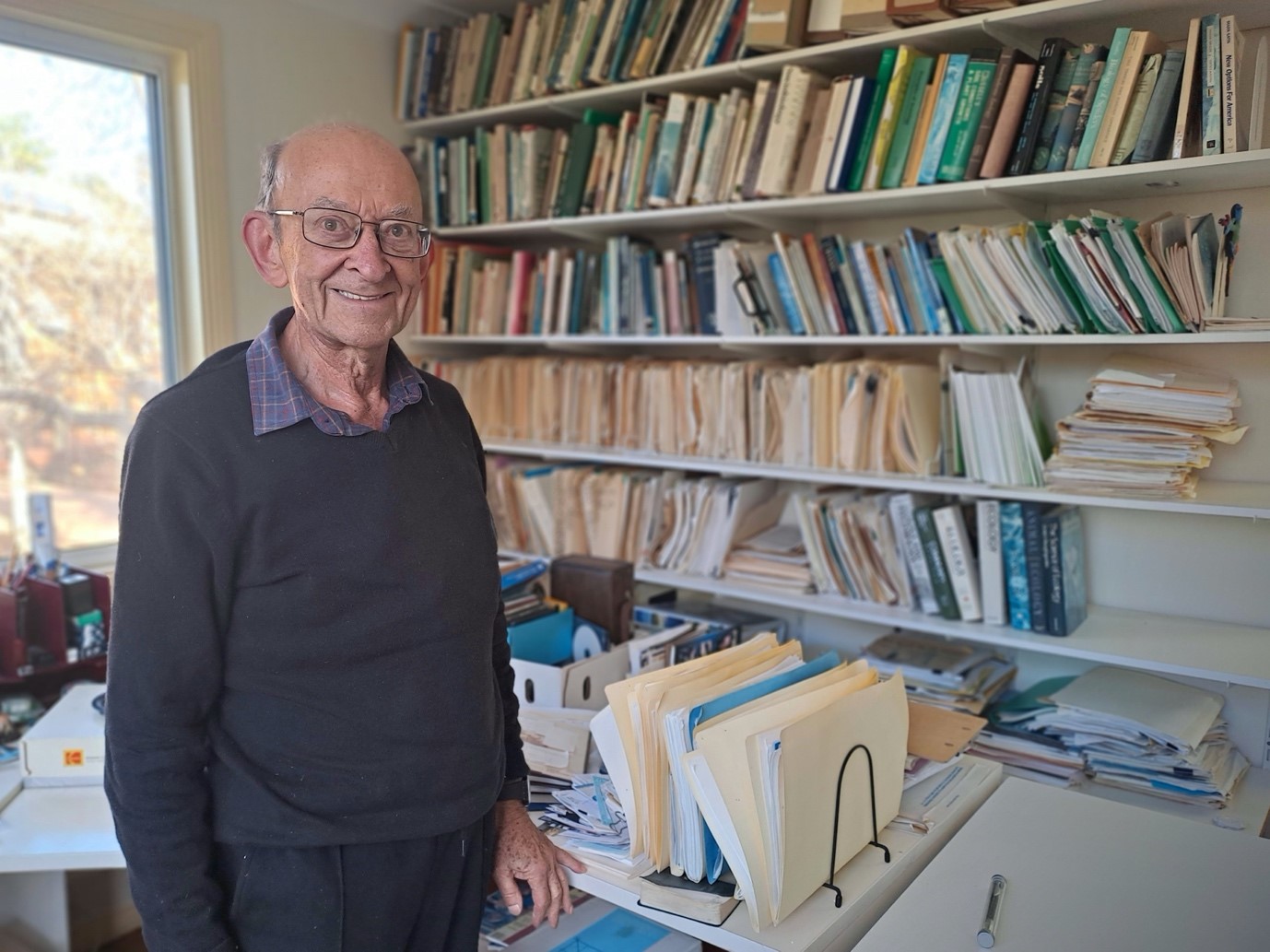
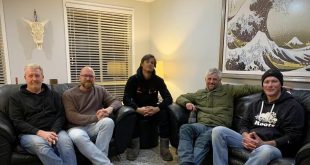
EmeritusProfessor Stuart Hill in his study. (Photo: Belle Butler)
Life is made up of complex systems in which everything is inter-connected. Over his decades-long teaching career, Stuart Hill, a retired Emeritus Professor, and Linden resident, has helped hundreds of students understand the critical links between human actions and the health of our planet.
Key Points:
The interconnectedness of life systems: Professor Hill’s research on the ecosystem of a bat cave, and soil ecology, has highlighted the intricate relationships between organisms and their environment.
The importance of holistic thinking: By studying entire ecosystems, Professor Hill emphasised the need to consider all components of a system, rather than focusing on individual elements.
The potential of untapped resources: Professor Hill believes that understanding the unseen processes of nature, such as those occurring in soil, holds the key to addressing global challenges.
Professor Hill’s own thinking has stemmed from an everlasting love of, and connection with nature and has built on his early research as a zoologist in the mid 60s. His PhD involved the study of a bat cave in Trinidad: a complete, almost self-contained ecosystem in which it was actually possible to observe and measure all the complex relationships that create life. One of the smallest beetles in the world, that he discovered in that cave, is even named after him: Micridium hilli.
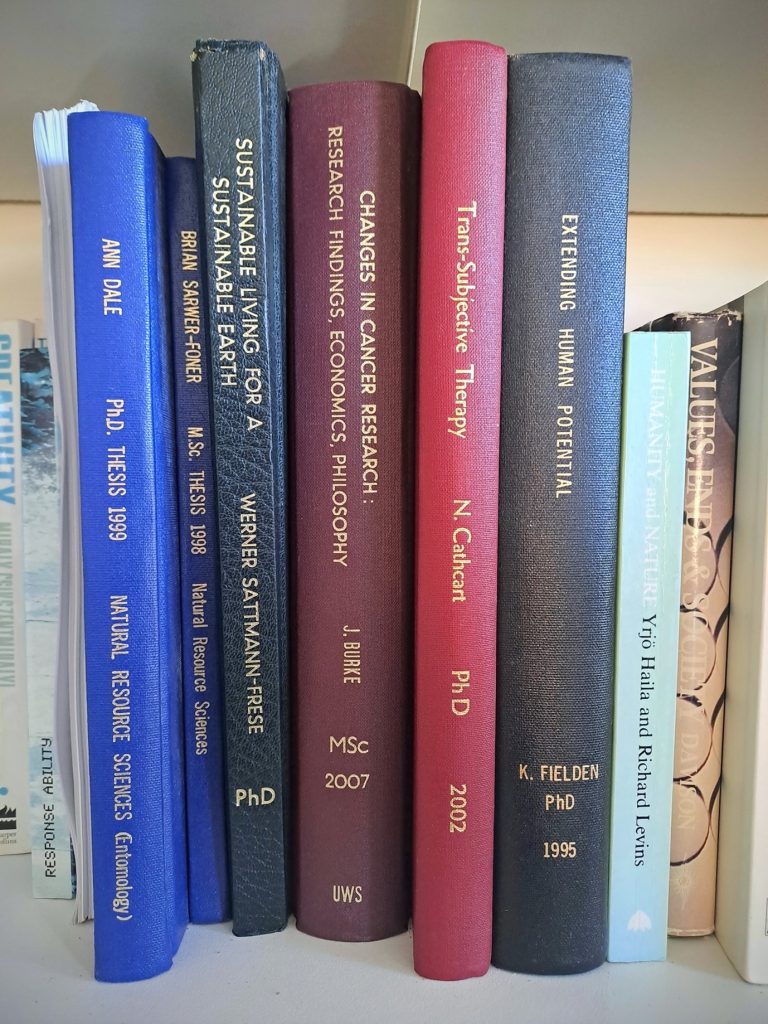
Ann Dale, his last PhD student at McGill University in Canada in the 70’s, went on to establish the government’s first ‘National Round Table for the Economy and the Environment’- recognising that our economies profoundly impact both human health and the health of the planet.
EmeritusProfessor Stuart Hill has inspired the work of many students and contributed to many publications. (Photo: Belle Butler)
Once known as ‘Mr Organics’ he was responsible for facilitating the research in the 70s that validated the benefits of organic farming. Much of the experience that he brought to this derived from his early studies in the Bat cave in Trinidad.
Learning from the bat cave
Professor Hill’s recollections of his PhD research:
“There were a quarter of a million bats and all sorts of other things in the cave, but it turned out that most of the cave life was in the guano, the bat droppings. In much of the cave the guano was half a metre deep, and when I actually measured its respiratory rate I found it was respiring at the same rate as a domestic cat. That’s how dynamic it was. It was a heaving living mass because of the presence of microorganisms, microarthropods, cockroaches, and a range of other arthropods.”
“In the process I became interested in life in the soil, which was the closest thing to this guano. When I finished the work I was essentially writing up a PhD thesis on the ecology of a very special type of soil. I had gained an understanding of soil ecology, way beyond what anybody else had discovered. Up to that time, those studying life in the soil were specialising — they were looking at the fungi, or the bacteria, or the insect life, but not at the whole system. Whereas I was studying the whole system and studied energy flow and community relationships in the guano, which was just like a very fertile soil.”
“I also compared guano with soil outside the cave. Through my research, my interest shifted from a focus on marine ecology to a focus on soil and terrestrial ecology, and particularly the relationships between micro-arthropods, especially mites, and the fungi.”
“In soil there are really three sub ecosystems. Soil is made up of little particles and those particles are surrounded by a water film. In between there’s a space. Some organisms are living in the water film, particularly bacteria, protozoa, nematodes, rotifers and things that swim.”
“Then there are fungi that grow out into the air spaces, and a whole lot of animals, such as mites and springtails, that are dependent on those air spaces to walk around and feed on the fungi, similar to cows feeding on grass. What I discovered was that those organisms were actually ‘farming’ the fungi. Nobody had really understood this because they mostly looked at the various types of organisms separately.”
“The third sub ecosystem comprises the organisms that can actually move through the soil by creating spaces, such as earthworms. They’re not dependent on the spaces that already exist, they’re actually pushing through and creating their own spaces. We humans have a mucus lining in our gut, while in contrast micro-arthropods have an extension of their exoskeleton lining their gut. They’re covered in chitin outside and that actually extends all through their gut as a sleeve, or lining.”
“When they eat fungi they eat the hypha and the spores, and chomp it all up. They digest the hypha but not the spores, the spores survive. Each time they poo they cast off a little bit of the sleeve of the gut lining and inside that little faecal pellet, which is like compost, are fungal spores. When this faecal pellet is deposited in the soil the chitinous sleeve protects it from being accessed by fungi other than those that have germinated from the contained spores. So, in a sense, they are practicing ‘weed control’.”
Stuart argues that it is the things that we can’t see, in this case the life in the soil and the processes going on, and what goes on in our subconscious, that are in a sense our greatest hope for the future. They’re our greatest untapped resource.
Until he retired in 2009, Stuart spent more than 20 years as the Foundation Chair of Social Ecology at Western Sydney University, training many more young people in systems thinking. He firmly believes that social change requires a willingness to learn both from nature and from other people, to pay attention to ‘the things we can’t see’ and to take a holistic and pluralistic approach, in which we pay much more attention to practitioners on the ground who gain their wisdom from actual experience.
This story has been produced as part of a Bioregional Collaboration for Planetary Health and is supported by the Disaster Risk Reduction Fund (DRRF). The DRRF is jointly funded by the Australian and New South Wales governments.
We had a thoroughly enjoyable final Skill Share Saturday for the year yesterday with Qigong, Fashion Upcycling, Seed Saving and Bushcare! We shared seeds from local gardens and harvested carrots, as well as Mizuna, Broad Bean, Daikon and Land Cress seeds from the Planetary Health garden. We then packaged up (and shared) our first Upper Mountains Seed Savers packs for our fledgling Seed Bank. In Bushcare it`s very exciting to see whole new areas of the Planetary Health Precinct open up as we remove invasive weeds. It`s been a year of great progress as we`ve restored habitat for wildlife and given local native plants the opportunity to flourish and re-establish on the site.
Join the Planetary Health Centre this Sat 6 Dec for the last Skill Share Saturday of the year: Qigong at 9am, Seed Saving & Gardening Group at 10am, and Bushcare at 1.30pm. One perfect day with great company, great coffee and food, and great steps for living a healthy balanced life, while also contributing to the health of our planet for present and future generations. All ages welcome!
Registration links in profile and below.
Register for Qigong here: https://bit.ly/48wlHjD Register for Seed Saving & Gardening here: https://bit.ly/4prcRe7 Register for Bushcare here: https://bit.ly/4oAFDrz
We have a rare opportunity to learn about the newest and best possible ways to support family and community members struggling with mental health issues, at a free talk and afternoon tea provided by Upper Blue Mountains Sunrise Rotary at the Planetary Health Centre at 2pm this Saturday 29 Nov. Hear from Peter Joseph AM, Chair of the Black Dog Institute, and Professor Helen Christensen AO, Fellow of the Australian Academy of Science and former Executive Director and Chief Scientist at the Black Dog Institute. They`ll be in conversation with journalist Emma Rossi. Dr Christensen is a pioneer in using the internet to reach young people struggling with depression. Her digital mental health interventions are used by millions globally, delivering evidence-based therapy for depression, anxiety, and suicide prevention. Her research uses data from smartphones and wearables – like movement, screen use, and sleep – to detect early signs of mental health issues. Bookings essential here (link in profile): https://bit.ly/4oOnYxz
This Saturday Sherlie McMillan from Rotarians 4 Planetary Health will be running a workshop on How to use a sewing machine from 9am at the Planetary Health Centre in Katoomba. Learn how to set up a machine, service it, troubleshoot when it`s not sewing correctly, and learn some basic sewing skills.
Bookings essential here (link in profile): https://events.humanitix.com/how-to-use-your-sewing-machine
NB. This class is a prerequisite for our very popular Fashion Upcycling classes held once a month.
We`re thrilled to announce that Professor Helen Christensen, a pioneer in using the internet to reach young people struggling with depression, will be joining the conversation with Peter Joseph AM from the Black Dog Institute and journalist Emma Rossi at the Planetary Health Centre at 2pm this Saturday 29 November. Helen was the Executive Director and Chief Scientist for the Black Dog Institute for 10 years and has now been elected a Fellow of the Australian Academy of Science. Her digital mental health interventions are used by millions globally, delivering evidence-based therapy for depression, anxiety, and suicide prevention. Her research uses data from smartphones and wearables – like movement, screen use, and sleep – to detect early signs of mental health issues. This free event is being co-hosted by Upper Blue Mountains Sunrise Rotary and the Blue Mountains Planetary Health Initiative. Afternoon tea will be provided. Bookings essential here (link in profile): https://bit.ly/4oOnYxz
Human composting is increasingly being legalised around the world. Read about it in Katoomba Area Local News here (link in profile): https://www.katoombalocalnews.com/legalising-human-composting/
If you’d like to see this option available in NSW you can now sign a live petition to the NSW Parliament here (link in profile): https://bit.ly/43QIHbz
Thanks to everyone who contributed to deliver a fantastic Disaster Risk Awareness Expo and Family Day yesterday. @mark_greenhill_mayor opened the event at which we celebrated the 13th birthday of Betty the Asbestos Education House; @firecoat_au demonstrated and launched its range of fire retardant products that can help protect homes, gardens and even electricity poles; the Bushfire Retrofit Toolkit was launched; Santa arrived and delighted young and old; and @plantinspired99 and Action for Animals fed us all with a delicious plant-based sausage sizzle. The day was filled with talks, workshops, stalls and the sharing of a huge amount of expertise to keep us, and the other species we share our planet with, safe and healthy! @southkatoomba.rfb @nswses @fireandrescuensw @nswrfs @redcrossleura @redcrossau @shelter.building.design @firehalo.au @asbestosawareness @amelie_ecology @bbagsbluemtns @wireswildliferescue @handsheartfeet
Our marquee is up and we`re excited about our Expo and Family Day tomorrow (Sat 22 Nov). There`s something for everyone from a free sausage sizzle, plants from Santa and drumming and pollinator workshops, to sessions on keeping you and our community safe from extreme weather events and hazardous substances like mould and asbestos. Learn how intumescent paints can slow the spread of fire and pick up a sample pot; check out all our emergency service organisations; learn how to dispose of hazardous materials; paint a native orchid, make some seed balls or sew a boomerang bag to give as plastic-free Christmas presents this year; enjoy coffee and locally made sweets; and get tips on how to retrofit your home safely and beautifully to be prepared for future extreme weather events. View the full program and register here (link in profile): https://bit.ly/4nFrY1J
There are so many new and innovative ways of doing things, like the new cooking techniques being explored by Michael from Good Fat Pastry, and the new fire protection methods being launched at the Planetary Health Centre`s Expo and Family Day on Sat 22 Nov. Check out Michael’s recent presentation at the Food Security Fair in our video here: https://bit.ly/4pnXbIg (link in profile) and come along to taste his delicious carrot cake and pastries at the Expo on Saturday. Check out the program and register to attend here (link in profile): https://bit.ly/4nFrY1J
In 2006 Peter Joseph’s son Michael suicided after a 14-year episodic battle with mental illness. Peter is now the Chair of the Black Dog Institute which is working to achieve better outcomes for all those struggling with mental health issues. Journalist Emma Rossi will engage Peter in an intimate and moving conversation about a life of purpose and mental health advocacy. As a Rotary scholar Peter will also reflect on how Rotary helped shape his values and sense of purpose as a young man - and how those early lessons continue to guide his work today. This free event is being hosted by the Upper Blue Mountains Sunrise Rotary Club and the Blue Mountains Planetary Health Initiative on Saturday 29 November from 2-4pm at the Planetary Health Centre at 33-39 Acacia St Katoomba. Afternoon tea will be provided. Bookings essential here (link in profile): https://bit.ly/4oOnYxz
Learn about intumescent fire retardant paint and a range of other strategies to prepare for extreme weather events, and to manage hazardous materials, at the upcoming Expo and Family Day at the Planetary Health Centre on Sat 22 Nov. You can register to attend here (link in profile): https://bit.ly/4nFrY1J We checked out how intumescent paint works in this video.
When temperatures reach a certain point the intumescent paint begins to swell and expand, often up to 50 times its original thickness. It forms a thick, carbonaceous "char" that acts as an insulating barrier. This layer slows the rate at which heat reaches the structural elements and buys valuable time for people to safely exit a building during a fire. It makes the structure safer for firefighters and rescue teams. #intumescentpaint #fireretardant #bushfire @firecoat_au...
Mould, lead paint, asbestos, silica dust from engineered stone bench tops and a wide range of chemicals, are amongst some of the many hazardous substances entering our environment and negatively impacting our health. Asbestos is found in over 3000 products including textured paints, moulded garden pots, brake pads and clutch linings in older cars, floor and ceiling tiles, lino, fibro, roofing, pipes and gutters, hot water systems, backing for switchboards and insulation boards in air-conditioning ducts, insulation, sealants, fillers, caulking and adhesives, gaskets for industrial and lab equipment and more. We’ll have information to take away and Blue Mountains City Council and the Asbestos and Hazardous Materials Consultants Association (AHCA) will be running free workshops on how to identify and manage these hazardous substances at the Planetary Health Centre`s Disaster Risk Awareness Expo in Katoomba on Sat 22 Nov. Find out more and register to attend here (link in profile): https://bit.ly/4nFrY1J
Blue Mountains City Council’s Planetary Health Initiative is working in collaboration with all sectors of the community to provide not for profit local news focused on solutions.
When Dan Gaffney found out he was having a son, it prompted action to break a cycle of inter-generational disconnection. What began as a personal commitment to self-work has since grown into a powerful communal practice helping men become more emotionally literate, accountable, conscious and connected.
Enjoyed this article? Please help spread the word :)
Support the Future of Solutions-Focused Neighbourhood News