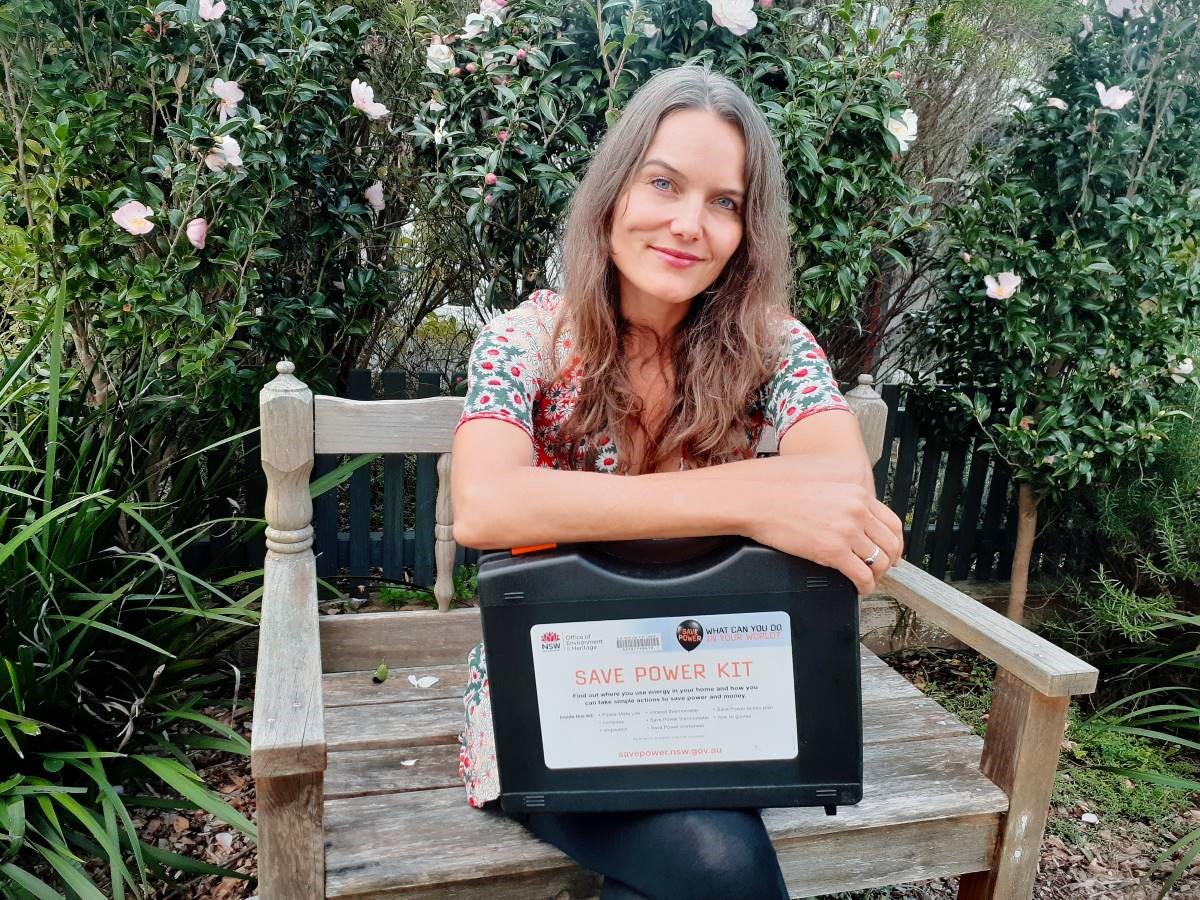
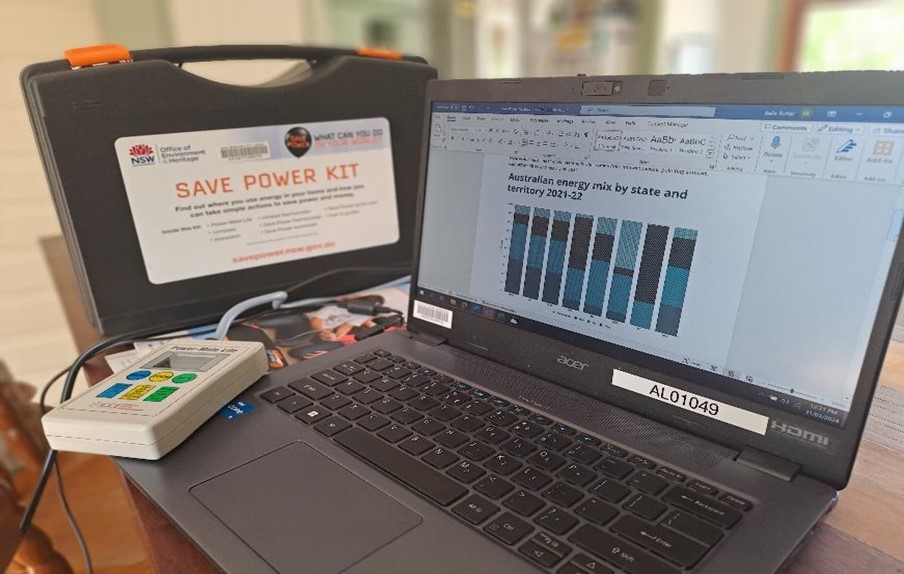
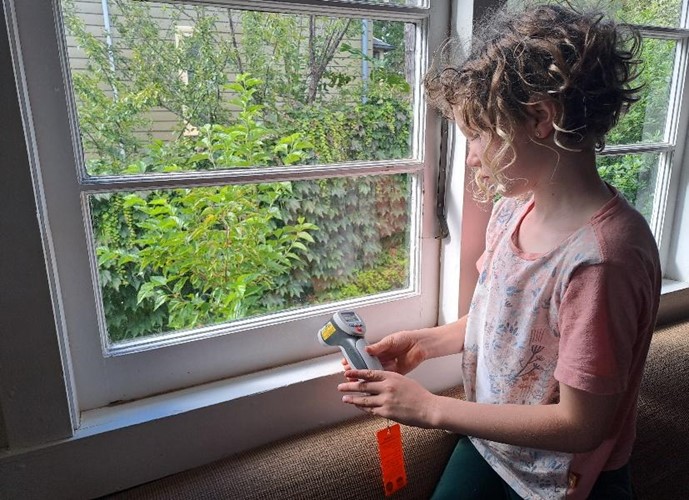
Belle Butler with a ‘My Energy and Water Saver’ kit borrowed from the library. (Photo by Nahla)
Story and photos by Belle Butler
Blue Mountains libraries now stock free-to-borrow ‘My Energy and Water Saver’ kits that Blue Mountains residents can use to assess their homes for energy and water efficiency. Belle Butler borrowed one of the kits and discovered some room for improvement in her Lawson home.
Key Points:
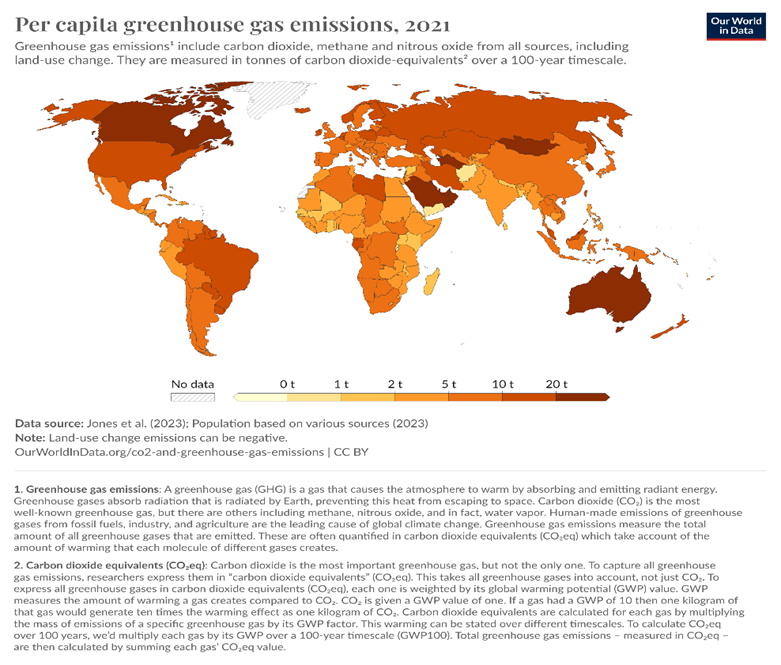
Most per capita greenhouse gas emissions come from the electricity and heating needs of homes.
The Climate Council touts energy-efficiency as one of the easiest, cheapest and fastest ways to reduce emissions.
Borrowing a kit from a Blue Mountains Library can help you maximise your energy efficiency, cut your emissions and save on your energy bill.
Climate change is an issue so big that sometimes, as one little person on the planet, it’s hard to know what to do. And when everyday life is filled to the brim with various expectations and commitments, ‘doing’ something at all can feel like a daunting task.
However, even some small changes to your everyday habits can make a difference. Unless you are running your household on renewable energy (if you are, then kudos!), much of your greenhouse gas input will come from the electricity and heating needs of your home.
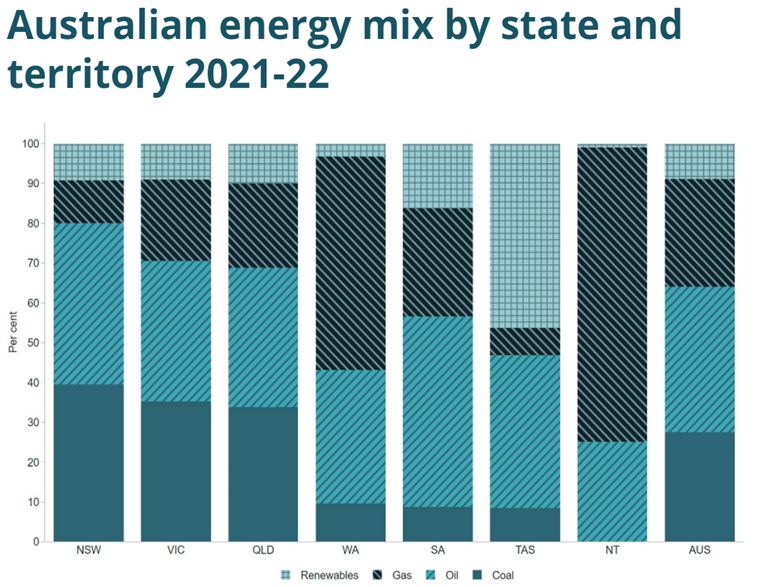
Here in Australia, most of our electricity still comes from non-renewable, polluting sources, with NSW still relying heavily on coal.
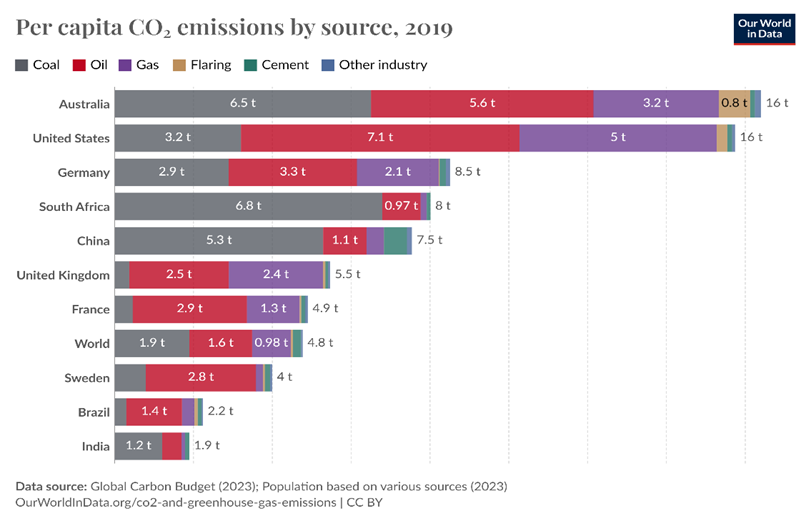
These graphs present a compelling argument for renewables, but if investing in household solar isn’t an option for you right now, making changes to how you use energy can reduce your emissions (and your electricity bill). The Climate Council touts energy-efficiency as one of the easiest, cheapest and fastest ways to reduce emissions.
Test your energy efficiency
Blue Mountains City Council has now introduced ‘My Energy and Water Saver’ kits to its branch libraries, which residents can borrow free of charge. The kits contain tools and a guide on how to use them in order to identify where household reductions in power and water usage might easily be made. The kits come with the following items:
Power Mate Lite – measures the amount of power drawn by an electrical appliance.
Infrared Thermometer – Measures temperature of objects to find where heat is lost or gained. Great for testing windows and doors for draughts.
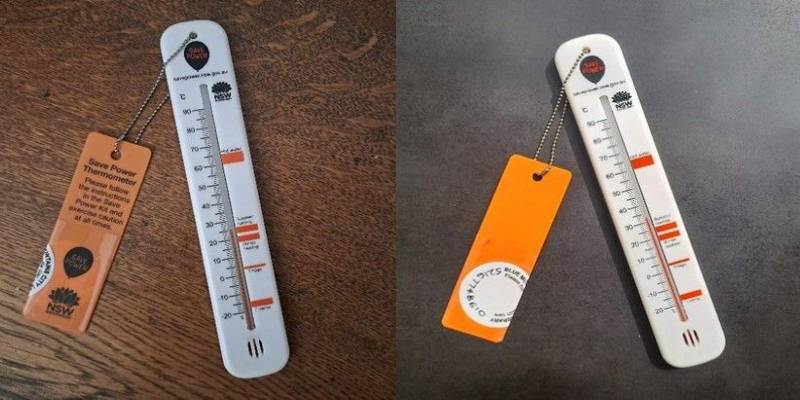
Thermometer – measures air temperature including in the fridge and freezer.
Compass – Identifies north and west facing rooms that receive the most sun.
Stopwatch – Used to measure flow rates of showerheads and taps.
Worksheets – Guides the user through helpful tests and allows for record-keeping of findings.
NB. The new version of the kit also includes a Thermal Imaging Camera (FLIR) which can measure radiant heat to help you prepare for future heat waves. It can also detect areas of energy loss in the home such as missing insulation, gaps in floorboards or around doors etc.
Testing out the energy consumption of my laptop while writing this article.
“Rising energy costs are a real concern for Blue Mountains residents,” said Mayor Mark Greenhill. “This kit is a simple and effective way to identify where heating or cooling might be escaping your home and make the necessary changes.
“Making your home more energy efficient is a key part of living sustainably and having an environmentally friendly lifestyle and this kit makes that process easy.”
Putting the Kit to Use
I live with my family in a draughty older Mountains home in need of some roof-work before solar panels can be installed. So we are classic candidates for this kit. Borrowing it from the library gave us an opportunity to talk to the kids about energy and water usage and then put our home to the test with some fun activities.
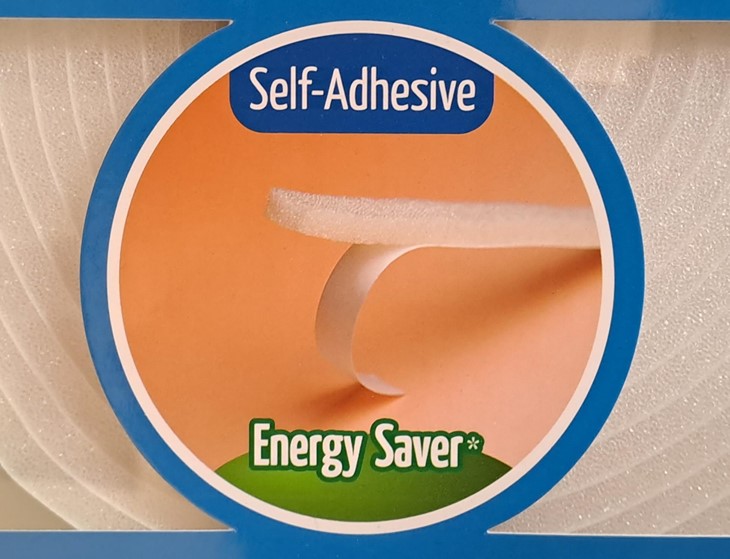
Draught tape can be purchased at hardware stores and easily applied around windows and doors to save on heating and cooling needs.
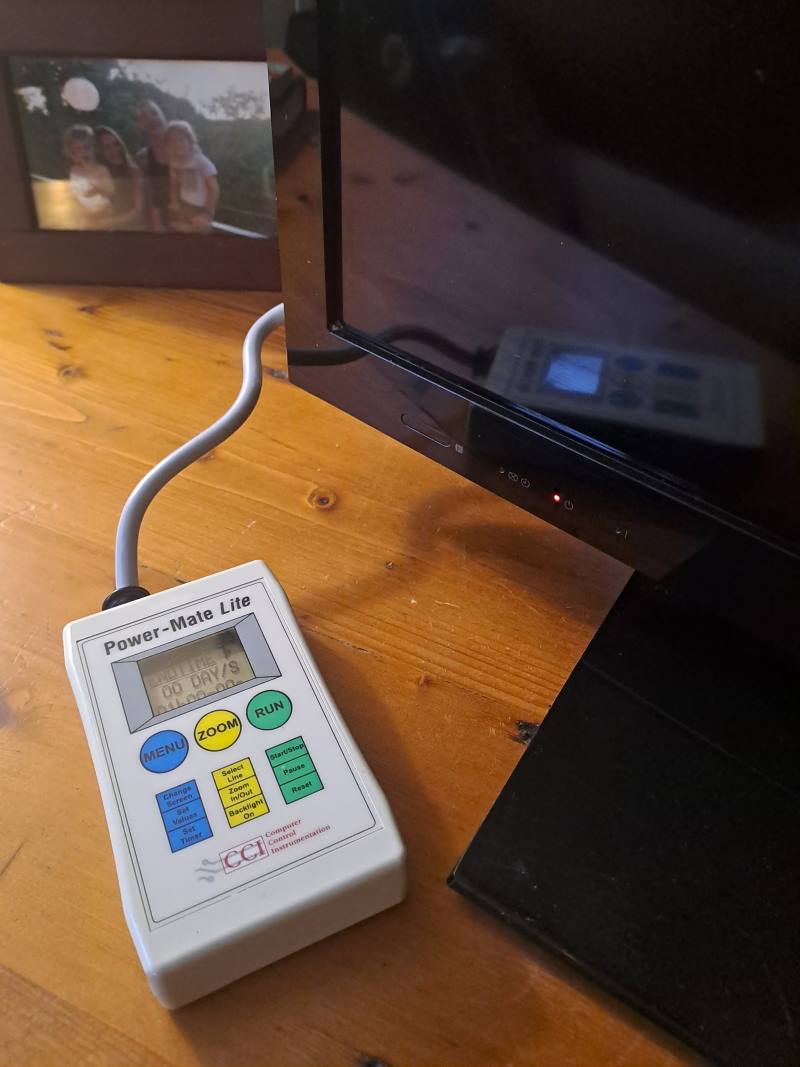
While we are probably considered more of a low-tech household, we still have the modern standards of a television and computers, and we found that we could make better choices by not leaving these devices on standby mode.
Our modest TV on standby amounts to about 50 kwh per year. Based on the emissions calculator on coolaustralia.org, that amounts to 43.5 kg Co2e (carbon dioxide equivalent, used to measure greenhouse gas emissions) each year. That seemed like a lot to me for an appliance that was just sleeping, and I wondered how many kilos of Co2e all the TVs on standby in the Blue Mountains are responsible for.
So I did a rough estimation based on the readings from my (comparatively small) TV applied to the number of dwellings in the Blue Mountains area according to the 2021 Census. If all 35,139 dwellings left one modest TV on standby for the entire year, and these households relied on the grid for their energy, these TVs would be responsible for 1,528,546.5 kg Co2e each year.
Testing the energy used by Belle’s TV while on standby
Obviously these are not official numbers. There are many variables not considered here, from size of TV and number of TVs per household, to whether households are turning off their TVs at the switch or running them partially or fully on solar energy. However, as a rough estimation, that’s a lot of pollution coming from sleeping screens in the Blue Mountains.
In another experiment, my son was able to measure how much energy is wasted when he forgets to turn off his bedside lamp for the day, after turning it on to read when he wakes up in the morning. Rough estimations on how often he does this resulted in about 1kg of Co2e emitted by a forgotten lamp each year.
We also measured the flow rate of our showerhead (below the maximum recommendation of 9 litres a minute), the temperatures of our fridge and freezer (just right), and the temperature difference between our west facing kitchen and our internal living room at 3pm on a warm autumn day: 33 degrees versus a pleasant 25 degrees. Time for double-glazing!
Thermometer reveals a nearly 10 degree difference between a western-facing room and an internal room on an Autumn day.
My daughter’s favourite activity was finding draughts in our windows (as well as testing her own temperature and mine) with the infrared thermometer. Although many of these windows already had draught tape, the thermometer revealed that most of the tape had worn through and needs replacing.
Nahla watching the temperature jump around on the infrared thermometer due to a window draught (on a day with very little wind).
Borrowing the ‘My Energy and Water Saver’ kit was a practical way of reassessing our electricity and water consumption habits, and it made the responsibility of household emissions more real and easily grasped for both the kids and the adults of our little abode.
Needless to say, the TV is no longer on standby and when my son forgets to turn off his bedside lamp, my daughter is quick to pull him up on it (“Leo, you left your lamp on, AGAIN!”).
If you’d like to understand your energy and water habits more comprehensively and make changes to reduce your emissions, I highly recommend borrowing this kit. You can also give feedback about your experience and tips for improvement at yoursay.bmcc.nsw.gov.au/my-energy-and-water-saver-kit.
Use the tools to assess your home for energy and water efficiency and make changes like turning devices off at the switch, applying draught tape to your windows and changing your shower head for an improved flow rate.
This story has been produced as part of a Bioregional Collaboration for Planetary Health and is supported by the Disaster Risk Reduction Fund (DRRF). The DRRF is jointly funded by the Australian and New South Wales governments.
We had a thoroughly enjoyable final Skill Share Saturday for the year yesterday with Qigong, Fashion Upcycling, Seed Saving and Bushcare! We shared seeds from local gardens and harvested carrots, as well as Mizuna, Broad Bean, Daikon and Land Cress seeds from the Planetary Health garden. We then packaged up (and shared) our first Upper Mountains Seed Savers packs for our fledgling Seed Bank. In Bushcare it`s very exciting to see whole new areas of the Planetary Health Precinct open up as we remove invasive weeds. It`s been a year of great progress as we`ve restored habitat for wildlife and given local native plants the opportunity to flourish and re-establish on the site.
Join the Planetary Health Centre this Sat 6 Dec for the last Skill Share Saturday of the year: Qigong at 9am, Seed Saving & Gardening Group at 10am, and Bushcare at 1.30pm. One perfect day with great company, great coffee and food, and great steps for living a healthy balanced life, while also contributing to the health of our planet for present and future generations. All ages welcome!
Registration links in profile and below.
Register for Qigong here: https://bit.ly/48wlHjD Register for Seed Saving & Gardening here: https://bit.ly/4prcRe7 Register for Bushcare here: https://bit.ly/4oAFDrz
We have a rare opportunity to learn about the newest and best possible ways to support family and community members struggling with mental health issues, at a free talk and afternoon tea provided by Upper Blue Mountains Sunrise Rotary at the Planetary Health Centre at 2pm this Saturday 29 Nov. Hear from Peter Joseph AM, Chair of the Black Dog Institute, and Professor Helen Christensen AO, Fellow of the Australian Academy of Science and former Executive Director and Chief Scientist at the Black Dog Institute. They`ll be in conversation with journalist Emma Rossi. Dr Christensen is a pioneer in using the internet to reach young people struggling with depression. Her digital mental health interventions are used by millions globally, delivering evidence-based therapy for depression, anxiety, and suicide prevention. Her research uses data from smartphones and wearables – like movement, screen use, and sleep – to detect early signs of mental health issues. Bookings essential here (link in profile): https://bit.ly/4oOnYxz
This Saturday Sherlie McMillan from Rotarians 4 Planetary Health will be running a workshop on How to use a sewing machine from 9am at the Planetary Health Centre in Katoomba. Learn how to set up a machine, service it, troubleshoot when it`s not sewing correctly, and learn some basic sewing skills.
Bookings essential here (link in profile): https://events.humanitix.com/how-to-use-your-sewing-machine
NB. This class is a prerequisite for our very popular Fashion Upcycling classes held once a month.
We`re thrilled to announce that Professor Helen Christensen, a pioneer in using the internet to reach young people struggling with depression, will be joining the conversation with Peter Joseph AM from the Black Dog Institute and journalist Emma Rossi at the Planetary Health Centre at 2pm this Saturday 29 November. Helen was the Executive Director and Chief Scientist for the Black Dog Institute for 10 years and has now been elected a Fellow of the Australian Academy of Science. Her digital mental health interventions are used by millions globally, delivering evidence-based therapy for depression, anxiety, and suicide prevention. Her research uses data from smartphones and wearables – like movement, screen use, and sleep – to detect early signs of mental health issues. This free event is being co-hosted by Upper Blue Mountains Sunrise Rotary and the Blue Mountains Planetary Health Initiative. Afternoon tea will be provided. Bookings essential here (link in profile): https://bit.ly/4oOnYxz
Human composting is increasingly being legalised around the world. Read about it in Katoomba Area Local News here (link in profile): https://www.katoombalocalnews.com/legalising-human-composting/
If you’d like to see this option available in NSW you can now sign a live petition to the NSW Parliament here (link in profile): https://bit.ly/43QIHbz
Thanks to everyone who contributed to deliver a fantastic Disaster Risk Awareness Expo and Family Day yesterday. @mark_greenhill_mayor opened the event at which we celebrated the 13th birthday of Betty the Asbestos Education House; @firecoat_au demonstrated and launched its range of fire retardant products that can help protect homes, gardens and even electricity poles; the Bushfire Retrofit Toolkit was launched; Santa arrived and delighted young and old; and @plantinspired99 and Action for Animals fed us all with a delicious plant-based sausage sizzle. The day was filled with talks, workshops, stalls and the sharing of a huge amount of expertise to keep us, and the other species we share our planet with, safe and healthy! @southkatoomba.rfb @nswses @fireandrescuensw @nswrfs @redcrossleura @redcrossau @shelter.building.design @firehalo.au @asbestosawareness @amelie_ecology @bbagsbluemtns @wireswildliferescue @handsheartfeet
Our marquee is up and we`re excited about our Expo and Family Day tomorrow (Sat 22 Nov). There`s something for everyone from a free sausage sizzle, plants from Santa and drumming and pollinator workshops, to sessions on keeping you and our community safe from extreme weather events and hazardous substances like mould and asbestos. Learn how intumescent paints can slow the spread of fire and pick up a sample pot; check out all our emergency service organisations; learn how to dispose of hazardous materials; paint a native orchid, make some seed balls or sew a boomerang bag to give as plastic-free Christmas presents this year; enjoy coffee and locally made sweets; and get tips on how to retrofit your home safely and beautifully to be prepared for future extreme weather events. View the full program and register here (link in profile): https://bit.ly/4nFrY1J
There are so many new and innovative ways of doing things, like the new cooking techniques being explored by Michael from Good Fat Pastry, and the new fire protection methods being launched at the Planetary Health Centre`s Expo and Family Day on Sat 22 Nov. Check out Michael’s recent presentation at the Food Security Fair in our video here: https://bit.ly/4pnXbIg (link in profile) and come along to taste his delicious carrot cake and pastries at the Expo on Saturday. Check out the program and register to attend here (link in profile): https://bit.ly/4nFrY1J
In 2006 Peter Joseph’s son Michael suicided after a 14-year episodic battle with mental illness. Peter is now the Chair of the Black Dog Institute which is working to achieve better outcomes for all those struggling with mental health issues. Journalist Emma Rossi will engage Peter in an intimate and moving conversation about a life of purpose and mental health advocacy. As a Rotary scholar Peter will also reflect on how Rotary helped shape his values and sense of purpose as a young man - and how those early lessons continue to guide his work today. This free event is being hosted by the Upper Blue Mountains Sunrise Rotary Club and the Blue Mountains Planetary Health Initiative on Saturday 29 November from 2-4pm at the Planetary Health Centre at 33-39 Acacia St Katoomba. Afternoon tea will be provided. Bookings essential here (link in profile): https://bit.ly/4oOnYxz
Learn about intumescent fire retardant paint and a range of other strategies to prepare for extreme weather events, and to manage hazardous materials, at the upcoming Expo and Family Day at the Planetary Health Centre on Sat 22 Nov. You can register to attend here (link in profile): https://bit.ly/4nFrY1J We checked out how intumescent paint works in this video.
When temperatures reach a certain point the intumescent paint begins to swell and expand, often up to 50 times its original thickness. It forms a thick, carbonaceous "char" that acts as an insulating barrier. This layer slows the rate at which heat reaches the structural elements and buys valuable time for people to safely exit a building during a fire. It makes the structure safer for firefighters and rescue teams. #intumescentpaint #fireretardant #bushfire @firecoat_au...
Mould, lead paint, asbestos, silica dust from engineered stone bench tops and a wide range of chemicals, are amongst some of the many hazardous substances entering our environment and negatively impacting our health. Asbestos is found in over 3000 products including textured paints, moulded garden pots, brake pads and clutch linings in older cars, floor and ceiling tiles, lino, fibro, roofing, pipes and gutters, hot water systems, backing for switchboards and insulation boards in air-conditioning ducts, insulation, sealants, fillers, caulking and adhesives, gaskets for industrial and lab equipment and more. We’ll have information to take away and Blue Mountains City Council and the Asbestos and Hazardous Materials Consultants Association (AHCA) will be running free workshops on how to identify and manage these hazardous substances at the Planetary Health Centre`s Disaster Risk Awareness Expo in Katoomba on Sat 22 Nov. Find out more and register to attend here (link in profile): https://bit.ly/4nFrY1J
Belle Butler is a writer, musician and occasional photographer. She likes mix-and-matching these artforms and often explores the same themes through each of them. Her short fiction has been published in numerous Australian literary journals and she recently received a WestWords Fellowship and Mentorship with Delia Falconer for her novel manuscript, ‘River.’ Hopefully it will be published one day.
When Dan Gaffney found out he was having a son, it prompted action to break a cycle of inter-generational disconnection. What began as a personal commitment to self-work has since grown into a powerful communal practice helping men become more emotionally literate, accountable, conscious and connected.
Enjoyed this article? Please help spread the word :)
Support the Future of Solutions-Focused Neighbourhood News